Skip to content Skip to sidebar Skip to footer
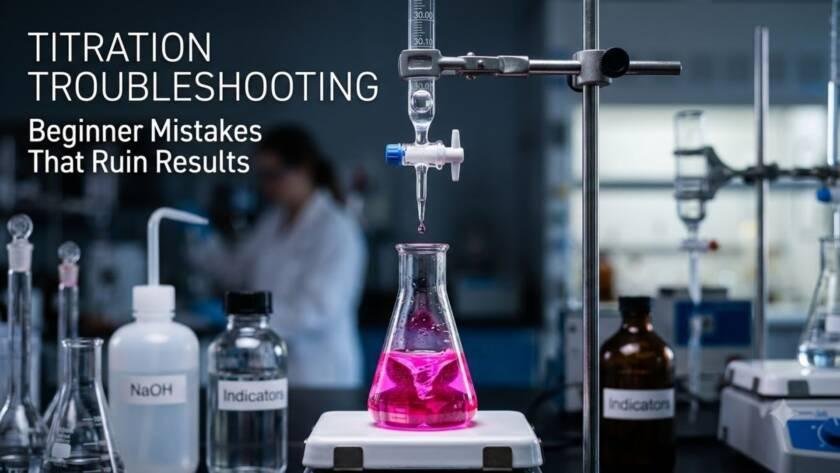
Titration Troubleshooting: Beginner Mistakes

Titration Troubleshooting: Beginner Mistakes That Ruin Results

Accurate titration depends on correct glassware preparation, meniscus reading and endpoint control.Titration results can be inaccurate even when the procedure appears simple. The most common causes are unconditioned glassware, contamination, air bubbles, parallax error, incorrect burette calculations, poor endpoint control, unsuitable indicators, unstandardized titrants and inconsistent technique between trials. This guide explains how to identify…

Read More

Learn what a conical flask is, including its uses, labeled parts, common types, glass vs plastic options, safety tips and how to choose one.

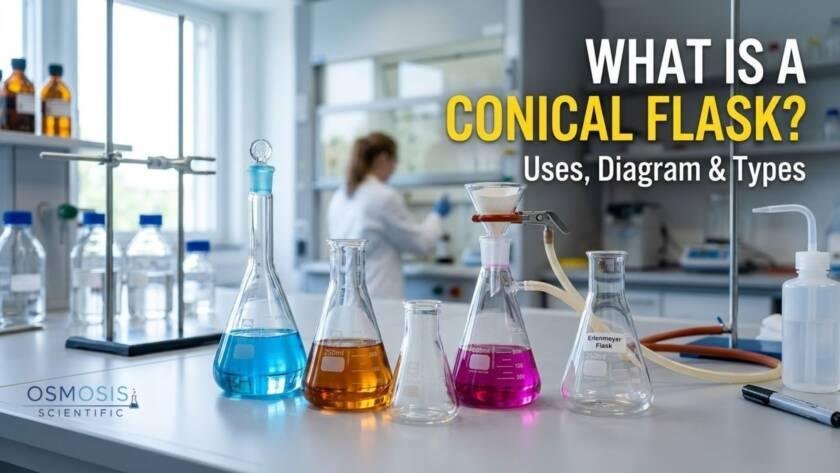
What Is a Conical Flask? Uses, Diagram & Types

A conical flask is a laboratory vessel with a wide, flat base, sloping sides and a narrow cylindrical neck. Also called an Erlenmeyer flask or titration flask, it is used for mixing, heating, holding, culturing and titrating liquids. Its stable base and narrow opening allow solutions to be swirled with less splashing. What Is a Conical Flask? A conical flask is a flat-bottomed laboratory flask whose body tapers upward into a narrow neck. The shape gives the vessel a low centre of gravity, while the neck helps reduce splashing and evaporation during mixing.Conical flasks are commonly made from borosilicate glass for laboratory work. Plastic versions are also available when low weight, shatter resistance or field use is more important than direct heating.The flask is not intended for highly accurate volume measurement. Its graduations are generally approximate; use a volumetric flask or calibrated measuring vessel when precise preparation is required. Conical Flask Diagram Main parts of a conical flask:A detailed engineering schematic of a 250ml Erlenmeyer flask mapped out on a blueprint grid. Callout lines map every design choice—from the ground glass joint (ST 24/40) and reinforced rim down to the tapered sides meant to keep liquids from splashing everywhere during aggressive swirling. Honestly? Half these specs feel like overkill until…

Read More
Borosilicate 3.3 vs. Soda-Lime Glass

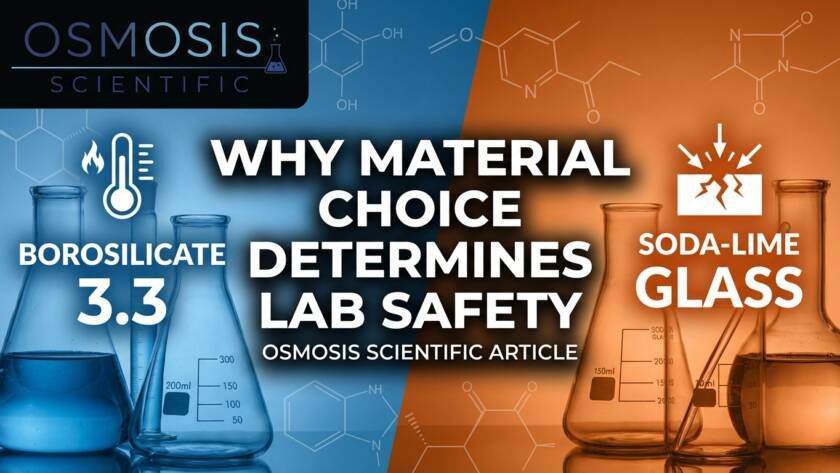
Borosilicate 3.3 vs. Soda-Lime Glass: Why Material Choice Determines Lab Safety.

Even “glass” isn’t a singular material in the lab. Borosilicate 3.3 and Soda-Lime behave very differently under heat and chemicals, and that divergence directly determines day-to-day lab safety. The most important safety lever is thermal expansion: Borosilicate 3.3 expands far less with temperature, building significantly less internal stress, making it much less likely to shatter…

Read More

5 Common Volumetric Measurement Errors & How to Avoid Them

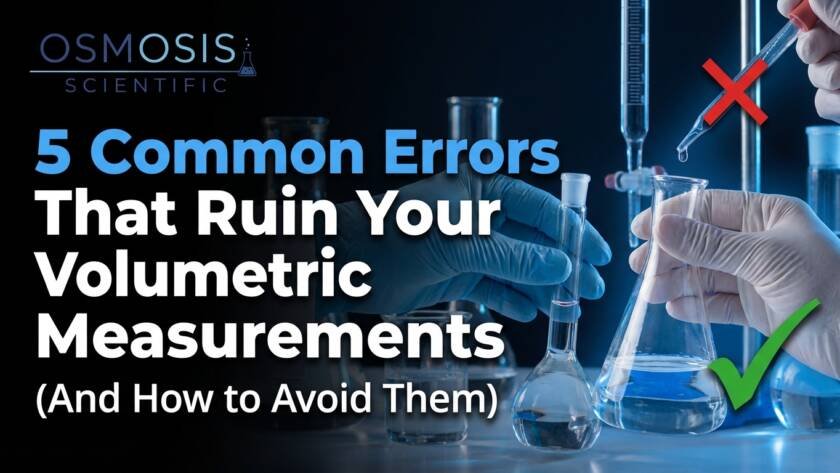
5 Common Errors That Ruin Your Volumetric Measurements (And How to Avoid Them)

Accurate volumetric measurements are the foundational integrity of quantitative chemistry.When results drift or fail to match theoretical values, the culprit is often not the chemistry itself, but a handful of repeatable technique and glassware errors. In high-precision analytical work, maintaining an error margin of 0.1% requires a rigorous understanding of the variables influencing liquid handling.…

Read More