A conical flask is a laboratory vessel with a wide, flat base, sloping sides and a narrow cylindrical neck. Also called an Erlenmeyer flask or titration flask, it is used for mixing, heating, holding, culturing and titrating liquids. Its stable base and narrow opening allow solutions to be swirled with less splashing.
What Is a Conical Flask?
A conical flask is a flat-bottomed laboratory flask whose body tapers upward into a narrow neck. The shape gives the vessel a low centre of gravity, while the neck helps reduce splashing and evaporation during mixing.
Conical flasks are commonly made from borosilicate glass for laboratory work. Plastic versions are also available when low weight, shatter resistance or field use is more important than direct heating.
The flask is not intended for highly accurate volume measurement. Its graduations are generally approximate; use a volumetric flask or calibrated measuring vessel when precise preparation is required.
Conical Flask Diagram
Main parts of a conical flask:
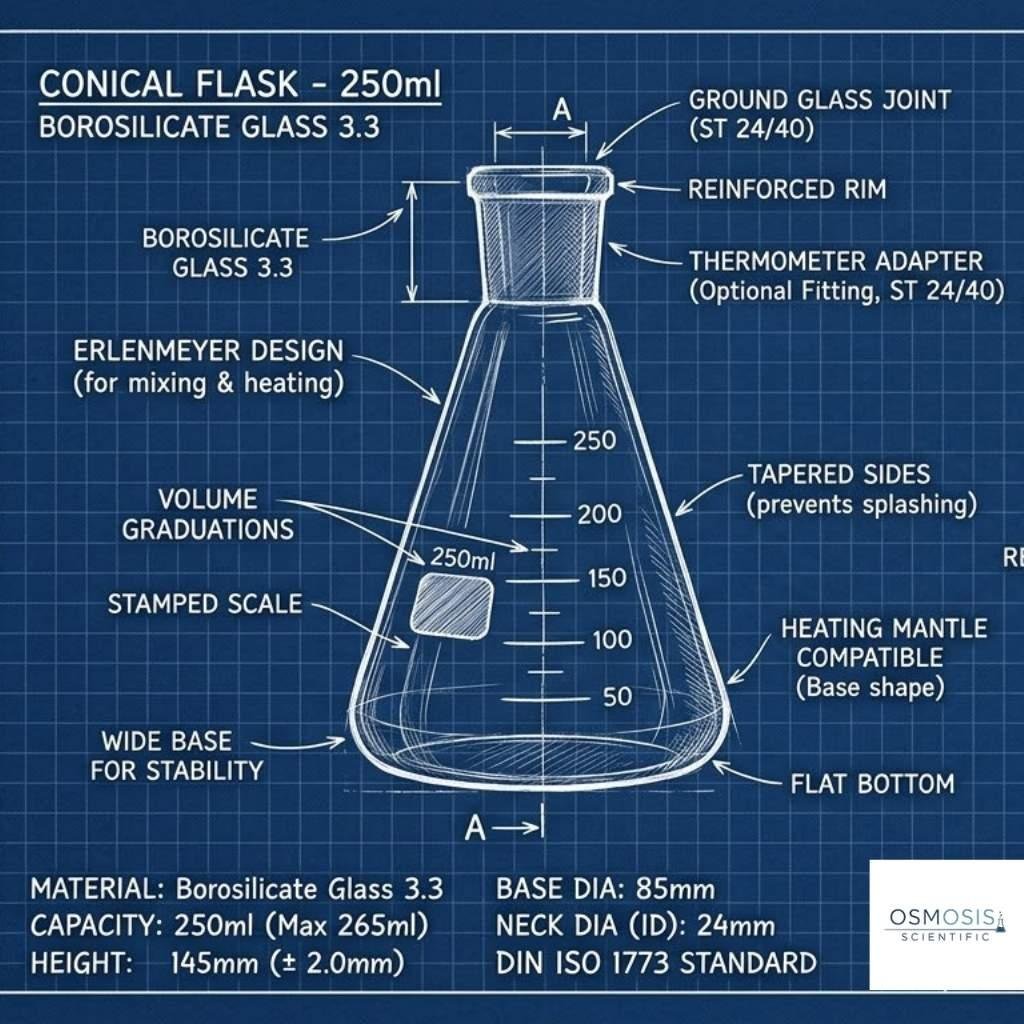
- Rim or mouth: The opening used to add liquids, powders or accessories such as funnels and stoppers.
- Neck: The narrow cylindrical section that helps control splashing and supports a stopper or cotton plug.
- Conical body: The sloping section that makes swirling safer and provides space for mixing.
- Flat base: The stable bottom that allows the flask to stand on a bench, hotplate or laboratory surface.
- Graduation marks: Approximate volume indicators used for general reference, not precision measurement.
Why Is It Called an Erlenmeyer Flask?
The conical flask is also called an Erlenmeyer flask after Emil Erlenmeyer, the German chemist associated with its design. “Conical flask” describes its shape, while “Erlenmeyer flask” is the common technical name used in laboratory catalogues and scientific education.
In some laboratories, it is also called a titration flask because its shape makes it practical for receiving titrant and swirling the solution during titration.
Uses of a Conical Flask
- Mixing and swirling solutions: The wide base and sloping walls allow liquids to be mixed by gentle swirling. The narrow neck helps contain the liquid and reduces the chance of splashes reaching the bench.volumetric flask
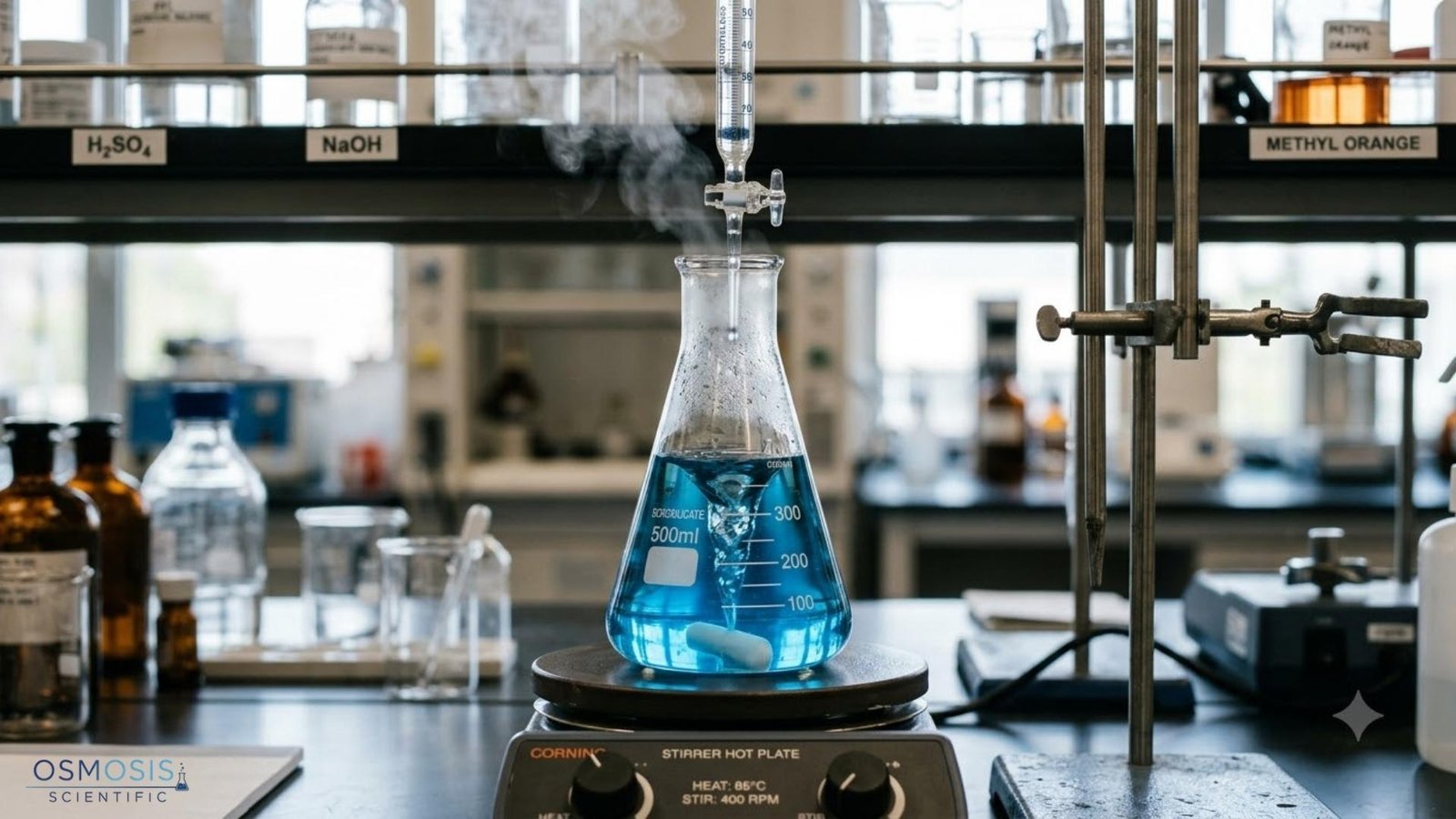
- Titration: During titration, the conical flask holds the analyte, indicator and other reagents while titrant is delivered from a burette.
- Heating liquids: Borosilicate conical flasks can be used for suitable heating applications on a hotplate, water bath or with controlled laboratory heating equipment.
- Preparing media and buffers: Used in biology, microbiology and analytical laboratories to prepare culture media, buffers and salt solutions.
- Microbial culture and shaking: Can hold microbial or cell-culture media during incubation and shaking.
- Temporary storage: With a suitable stopper or cap, it can temporarily hold prepared solutions and samples.
- Filtration: A standard conical flask can collect filtrate during gravity filtration.
Types of Conical Flasks
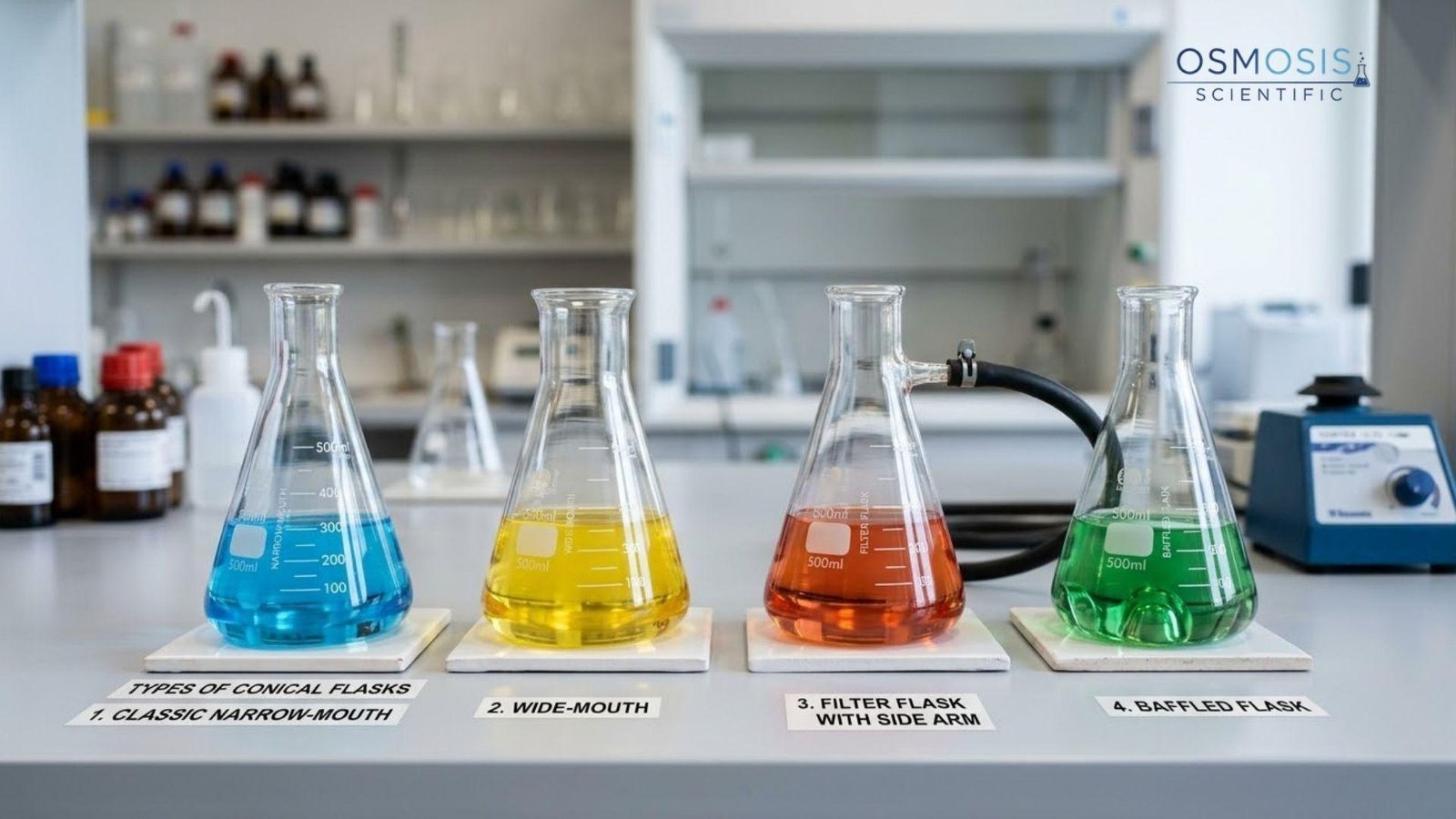
- Standard narrow-mouth conical flask: Suitable for general mixing, heating, titration and routine laboratory preparation.
- Wide-mouth conical flask: Features a larger opening for easier addition of powders, solids and viscous liquids.
- Graduated conical flask: Has approximate volume markings on the body for rough volume estimation.
- Stoppered conical flask: Accepts a glass, rubber or plastic stopper to protect from dust or evaporation.
- Screw-cap conical flask: Uses a threaded closure for transport, storage or culture work.
- Baffled conical flask: Features internal features that increase turbulence during shaking for improved aeration.
- Filter or Büchner flask: Has thicker walls and a side arm for vacuum filtration.
- Plastic conical flask: Made from materials such as polypropylene or polycarbonate, making them lightweight and shatter resistant.
How to Use a Conical Flask Safely
- Inspect the flask for chips, cracks and deep scratches before use.
- Do not heat damaged glassware or expose it to sudden temperature changes.
- Use a suitable holder, clamp or heat-resistant support when required.
- Leave enough headspace when mixing or heating liquids.
- Never seal a flask while heating unless the procedure specifically permits it.
- Label stored solutions clearly and follow chemical safety instructions.
- Clean promptly using a compatible method and avoid abrasive materials.
Glass vs Plastic Conical Flask
| Feature | Glass conical flask | Plastic conical flask |
|---|---|---|
| Heat resistance | Suitable glass grades can tolerate controlled heating | Depends strongly on the polymer; many are not suitable for direct heating |
| Chemical resistance | Borosilicate glass offers broad resistance to many laboratory chemicals | Varies by polymer and chemical |
| Visibility | Clear glass provides good sample visibility | Clear or translucent options are available |
| Breakage | Can break if dropped or damaged | Usually more resistant to impact |
| Reuse | Commonly washed and reused | Reuse depends on polymer, cleaning method and application |
| Best suited to | Heating, analytical work, general laboratory use | Field work, transport, teaching and shatter-resistant applications |
How to Choose the Right Conical Flask
Consider these points before selecting a flask:
- Capacity: Choose enough headspace for safe swirling and expansion during heating.
- Mouth type: Select narrow mouth for controlled pouring and reduced splashing, or wide mouth for powders and easier cleaning.
- Material: Choose borosilicate glass for many heating and laboratory applications; choose plastic when impact resistance is a priority.
- Closure: Select a stopper, screw cap or open mouth according to storage and contamination-control needs.
- Application: Use a filter flask for vacuum filtration and a baffled flask for enhanced shaking and aeration.
- Graduations: Treat markings as approximate unless the flask is specifically calibrated for accurate measurement.
Conical Flask vs Beaker
A conical flask has sloping sides and a narrow neck, while a beaker normally has straight sides, a wider opening and a pouring spout. The conical flask is generally better for swirling, titration and reducing splashing; the beaker is often more convenient for rapid pouring, stirring with a rod and adding solids.
Neither vessel should automatically be treated as a precision measuring instrument. Select calibrated glassware when the procedure requires an accurate volume.
Cleaning and Care
Rinse the flask soon after use so residues do not dry onto the glass. Use a suitable laboratory detergent and brush, then rinse thoroughly with clean water and, where required, purified water.
Allow the flask to drain and dry before storage. Keep it protected from impact, and do not return a flask to service if inspection reveals cracks, chips or serious scratches.
Conical Flasks from Osmosis Scientific
At Osmosis Scientific, we supply laboratory glassware for research, education, quality-control and industrial applications. Our conical flask range can support routine mixing, preparation, heating and titration work, with options selected according to capacity, mouth style, glass type and laboratory requirement.
For product specifications, bulk quantities or custom requirements, send an enquiry to our team.