
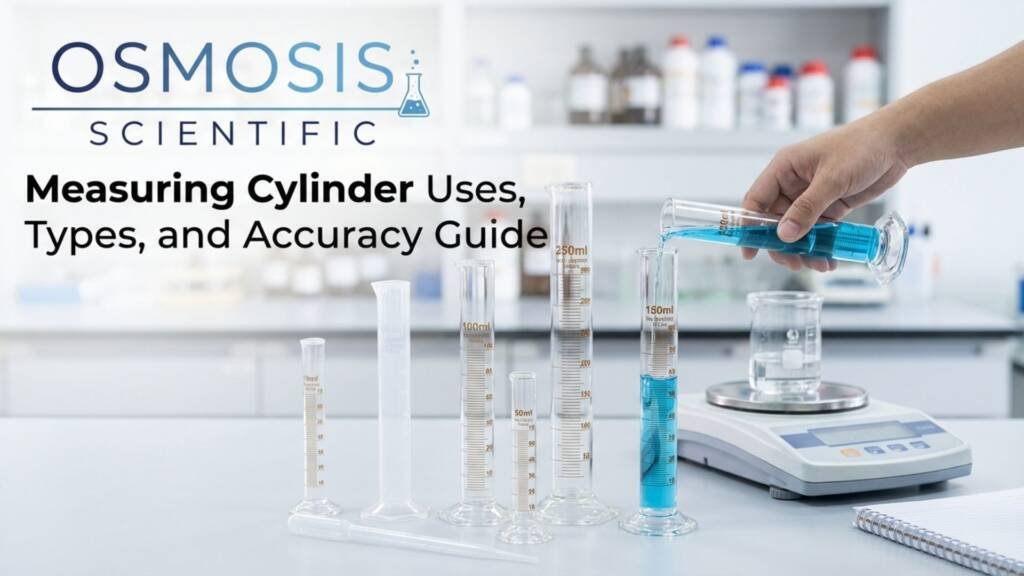
Measuring cylinders are the quiet workhorses of the lab—used all day for solution prep, QC checks, and student experiments—but they only deliver reliable data if you understand their uses, types, and accuracy limits.
From an Osmosis Scientific point of view, treating them as semi‑precise volumetric instruments (not just “taller beakers”) helps you match the right cylinder to the right job.
What is a measuring cylinder used for?
A measuring cylinder (graduated cylinder) is a tall, narrow vessel designed specifically to measure liquid volume more accurately than a beaker, while staying more flexible than a single‑volume flask. Its slim profile makes small changes in volume show up as larger height changes, which improves how precisely you can read the meniscus.
Across chemistry, biology, and environmental labs, cylinders handle routine tasks like measuring reagents, preparing solutions, performing density/displacement experiments, and collecting water samples. In industry, they support formulation, in‑process checks, and quality control in sectors such as pharmaceuticals, food and beverage, petrochemicals, and general manufacturing.
Measuring cylinder uses in real labs
The same piece of glass or plastic shows up in very different workflows; here are the main use‑clusters highlighted in laboratory research.
Chemistry and biology labs
- Solvent Prep: Measuring solvents, buffers, and growth media when you need moderate accuracy without the overhead of flasks or pipettes.
- Routine Analysis: Preparing reaction mixtures, titration volumes, and stock solutions where ±0.5–1 mL tolerance is acceptable.
Environmental and water‑quality testing
- Field Work: Measuring water and extract volumes for COD, salinity, or pollutant analyses.
- Sample Management: Doing displacement tests or holding samples for further work (e.g., transferring to flasks or instruments).
Pharmaceutical and clinical labs
- Formulation: Using Class A cylinders for bulk media, buffers, and non‑critical formulation volumes, while more precise steps use volumetric flasks or pipettes.
- Physical Testing: Supporting density tests and dissolution media preparation where you need repeatability but not sub‑0.1 mL precision.
Food, beverage and chemical industries
- QC Checks: Measuring ingredients, checking sugar or salt concentrations, and preparing QC samples.
- Process Control: Dosing additives or process chemicals, often in conjunction with density calculations.
Education and training
- Teaching Basics: Teaching students how to read menisci, avoid parallax, and understand displacement and density using robust plastic cylinders.
Types of measuring cylinders: materials and designs
Cylinders are categorized mainly by material, geometry, and base design, each with clear pros and cons.
By material
- Borosilicate glass: High chemical and thermal resistance, low thermal expansion, and excellent clarity. Preferred for Class A analytical cylinders, hot liquids, and aggressive reagents (except HF and strong hot alkali).
- Soda‑lime glass: Cheaper and more fragile, with higher thermal expansion and lower chemical resistance. Common in Class B student or general‑purpose cylinders where top‑tier precision isn’t required.
- Polypropylene (PP): Tough, lightweight, virtually unbreakable, and highly resistant to many acids and bases. Translucent rather than fully clear, which can make meniscus reading harder; ideal for teaching and HF use.
- Polymethylpentene (PMP / TPX): Glass‑like transparency combined with plastic safety; can reach Class A accuracy and withstand autoclaving. More brittle than PP, but excellent when you need both clarity and break resistance.
- HDPE: Extremely durable for rough industrial or field conditions, but often with poorer optical clarity and coarser graduations.
By geometry and form
- Tall form (Type 1): Classic slender design with a high aspect ratio, giving more vertical spacing between graduation marks and better resolution. Favoured for Class A cylinders where readability and accuracy matter.
- Squat form (Type 2): Shorter, wider body for improved stability and use in low‑headroom areas like fume hoods. Graduations are closer together, so these are typically limited to Class B accuracy.
Bases, tops and extras
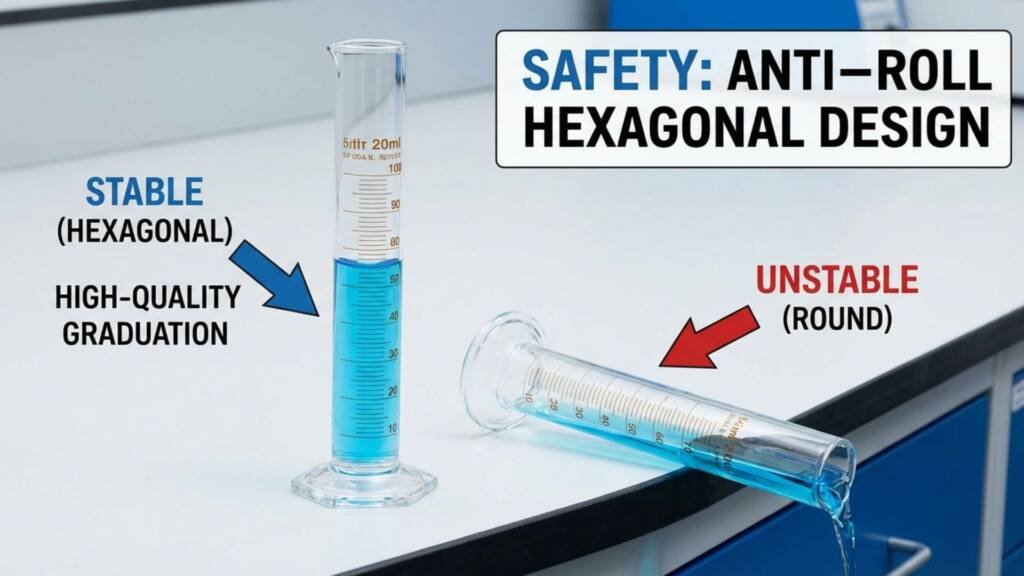
- Base types: Hexagonal or octagonal bases resist tipping and rolling and are standard on high‑quality cylinders. Round bases are more common on older or economy models and are less stable. Some glass cylinders use detachable plastic bases to absorb shock.
- Top endings: Spouted (beaded rim) cylinders are designed for easy pouring and are the default for “To Deliver” use. Stoppered mixing cylinders have ground joints and stoppers instead of spouts, allowing mixing but making pouring harder.
- Volume range: Standard capacities run from 5–10 mL micro‑cylinders up to 2,000 mL or more for bulk measurements.
Measuring cylinder accuracy: classes, standards and technique
The “accuracy” of a measuring cylinder is set not just by class and calibration standard but also by how it’s used at the bench.
Class A vs Class B
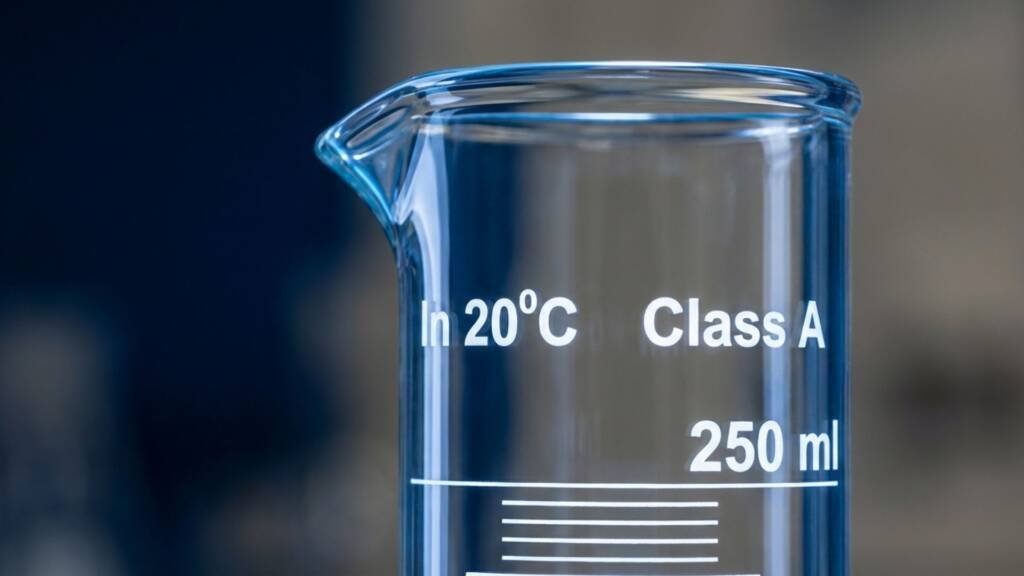
- Class A cylinders: Manufactured to tighter maximum permissible errors (MPEs) and often supplied with calibration certificates traceable to ISO or ASTM standards. Suitable for analytical work, formulation, and regulated QC where you need better than ~1% accuracy.
- Class B cylinders: Allow roughly twice the error of Class A and are intended for teaching labs, routine prep, and industrial tasks.
- Example: A 100 mL Class A cylinder may have a tolerance around 0.5 mL, whereas Class B at the same size commonly sits at 1.0 mL.
Standards and calibration concepts
Many cylinders comply with ISO 4788 or ASTM E1272. It is important to know which framework your glassware follows, because large‑volume tolerances differ slightly.
- To Contain (TC): Most cylinders are calibrated TC, meaning the indicated volume is what they hold internally. When you pour out, a film clings to the walls so the transferred volume is slightly less.
- To Deliver (TD): These are rarer; the manufacturer has calibrated them against what actually drains out, accounting for wetting losses.
- Note: For critical work, ignoring the TC/TD distinction can introduce systematic error.
Getting the best accuracy in practice
Your research emphasises that operator technique often matters as much as the printed tolerance.
- Level Surface: Place the cylinder on a level surface—don’t hold it in the air—so you avoid tilt error.
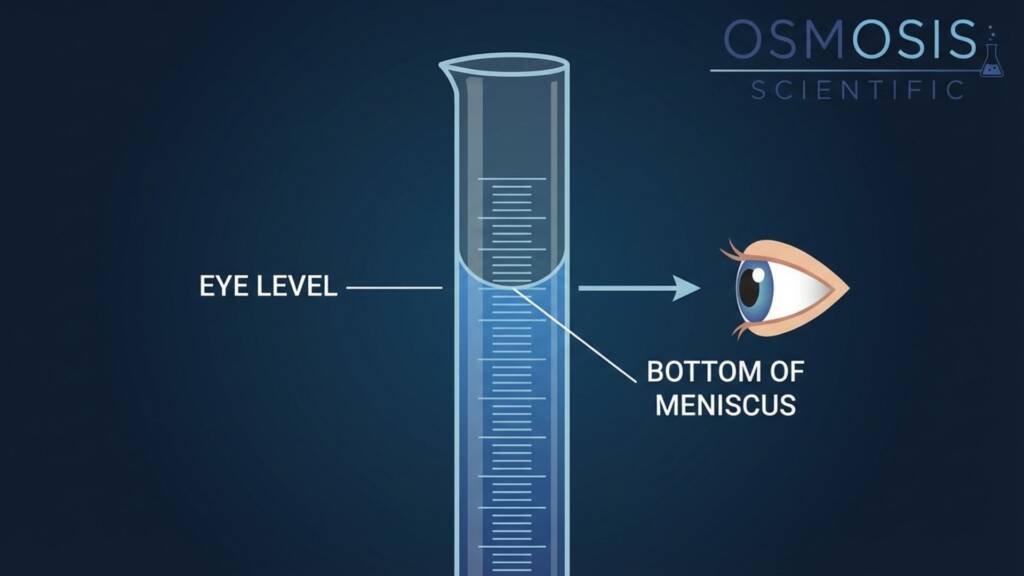
- Avoid Parallax: Bring your eye to the same height as the meniscus. Looking from above reads low; looking from below reads high.
- Read Correctly: For most aqueous liquids, read the bottom of the concave meniscus.
- Interpolate: If the meniscus sits between two lines, estimate to one extra digit (e.g., 6.55 mL on a 0.1 mL‑graduated cylinder).
- Cleanliness: Keep cylinders clean. Residues and grease distort the meniscus and prevent water from forming a uniform film.
Choosing the right cylinder for your application
For Osmosis Scientific customers, a practical way to decide is to balance accuracy needs, chemical conditions, and robustness.
- Borosilicate Class A: Use for analytical work, formulation, and wherever you need documented accuracy and chemical resistance.
- PP or HDPE Class B: Choose for teaching labs, field sampling, and HF/strong-alkali work where breakage is a bigger risk than sub‑millilitre uncertainty.
- PMP Class A: Select when you need glass‑like clarity with better impact resistance, such as in busy QC labs or petrochemical field setups.
- Capacity: Match capacity to your working range. Use small cylinders (10–100 mL) for resolution; large ones (250 mL–2 L) for bulk measurements.
Pro Tip: For solution prep that must hit a single exact volume, finish in a volumetric flask. For titration endpoints, switch to burettes. Measuring cylinders sit perfectly between these tools in the precision hierarchy.
A measuring cylinder is calibrated for volume and offers much tighter tolerances than a beaker, which has only rough, non‑certified markings. Use cylinders whenever the exact volume matters for your result.
Class A cylinders have stricter maximum permissible errors and are often individually certified, making them suitable for analytical work. Class B cylinders have roughly double the error and are used for teaching and routine prep.
High‑quality PMP cylinders can meet Class A specifications and rival glass in accuracy. However, standard PP and HDPE cylinders are typically Class B and prioritise durability over tight tolerances.
Most cylinders are “To Contain,” so the indicated volume refers to what’s inside. Treating a TC cylinder as TD adds a small but systematic under‑delivery that can matter in precise work.
Place the cylinder on a flat bench, bring your eye level with the meniscus, read the bottom of the curve (for water), and estimate between marks.
Explore our full range of Class A Borosilicate Measuring Cylinders—engineered for thermal shock resistance and certified precision.