

Reading a burette accurately comes down to one habit: align your eye with the meniscus every single time. In this guide, we’ll show you the correct reading technique, how to avoid parallax error, and how to calculate the exact volume dispensed during titration.
The Golden Rule of Volumetric Analysis (Don’t Skip This)
If you don’t move your head, you’re doing it wrong.
Your eye must move to follow the liquid level for both the initial and final readings. This is the only reliable way to eliminate parallax error—the #1 cause of wrong burette readings.
What a Burette Reading Actually Means
A burette is designed to deliver liquid precisely during titration. That’s why the scale is “opposite” of what many students expect:
- The 0 mark is at the top.
- The numbers increase as you move down.
- You record an initial reading, then a final reading.
- The volume dispensed is the difference between them.
Step-by-Step: How to Read a Burette (Correct Method)
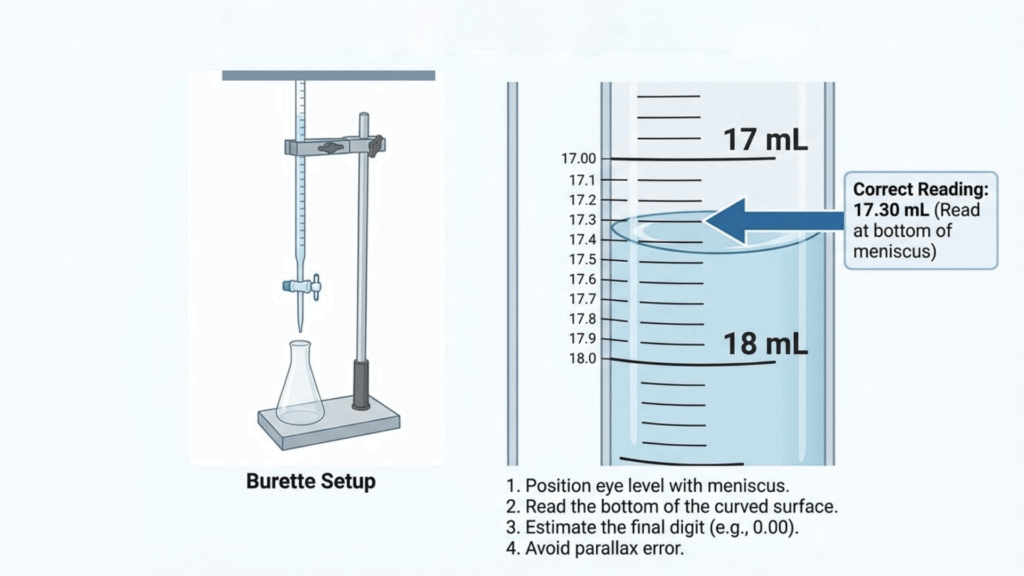
1) Set the burette up properly
- Clamp the burette vertically (straight up and down).
- Make sure the stopcock is closed before filling.
- Check the tip: it must be filled with solution (no trapped air bubble).
2) Improve visibility (simple trick that works)
To read accurately, you must clearly see the meniscus edge.
- Place a white background behind the burette.
- If available, use a burette reading card (a white card with a dark stripe) to sharpen the meniscus boundary.
3) Bring your eye to meniscus level (parallax control)
Move your head until your line of sight is perfectly horizontal with the meniscus.
- Looking from above makes the reading appear smaller.
- Looking from below makes the reading appear larger.
Always align your eye level first, then read.
4) Read the meniscus correctly (most important concept)
For most aqueous solutions, the meniscus is concave (a “U” shape). The correct reading is:
- Read the bottom of the meniscus (the lowest point of the curve).
If you ever work with a liquid that forms a convex meniscus, you read the top of the curve.
5) Record the initial reading (before titration)
Write the initial burette reading clearly in your notebook before you start dispensing.
Tip from our lab team: pause for 1–2 seconds before recording so the meniscus fully settles.
6) Dispense and record the final reading (after endpoint)
When you reach the endpoint, stop the flow, let the meniscus settle, and record the final reading using the exact same technique:
- White background/reading card
- Eye level alignment
- Correct meniscus point
Consistency is how you get repeatable results.
Worked Example (Table)
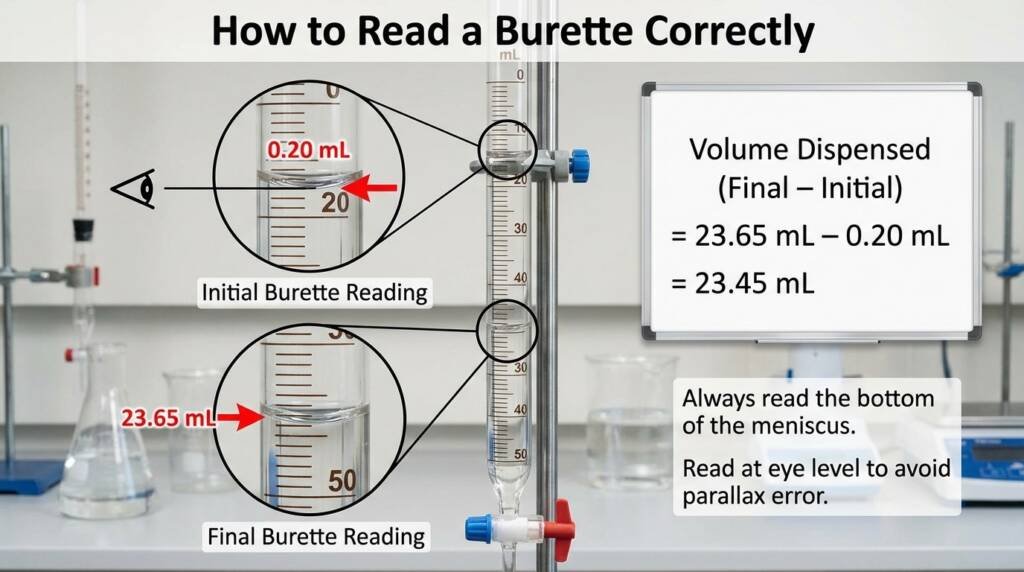
| Item | Value (mL) |
|---|---|
| Initial burette reading | 0.20 |
| Final burette reading | 23.65 |
| Volume dispensed (Final − Initial) | 23.45 |
Formula: Volume dispensed = Final reading − Initial reading
Common Mistakes (And How to Fix Them)
- Parallax error: You recorded while looking from above/below; fix by moving your eye to meniscus level every time.
- Burette not vertical: A tilted burette shifts the meniscus and throws off your reading; fix by clamping straight.
- Air bubble in the tip: Causes false volume delivery; fix by flushing solution through the tip until bubbles are removed.
- Not using contrast: The meniscus edge becomes hard to see; fix with a white background or a burette reading card.
- Forgetting subtraction: A burette reading is not “volume delivered”; always compute final − initial.
Clean glassware & consistency (credibility section)
Clean glassware and correct handling reduce meniscus distortion and improve repeatability, especially when you’re aiming for tight tolerances in analytical work. If you need a standards-based reference for volumetric practices and meniscus reading, NIST’s volumetric calibration procedures explicitly highlight proper eye position (eye normal to the scale/meniscus) as part of good measurement practice.
FAQs
For most aqueous solutions, read the bottom of the concave meniscus (the lowest point of the curve).
Because burettes are designed to measure volume delivered (dispensed). As liquid leaves the burette, the meniscus moves downward to higher numbers.
Parallax error happens when the scale is read from above or below the meniscus level, causing a false apparent volume.
Volume dispensed = Final burette reading − Initial burette reading.
Use a white background or a burette reading card behind the burette, and ensure your eye is perfectly level with the meniscus before reading.



1 Comment