

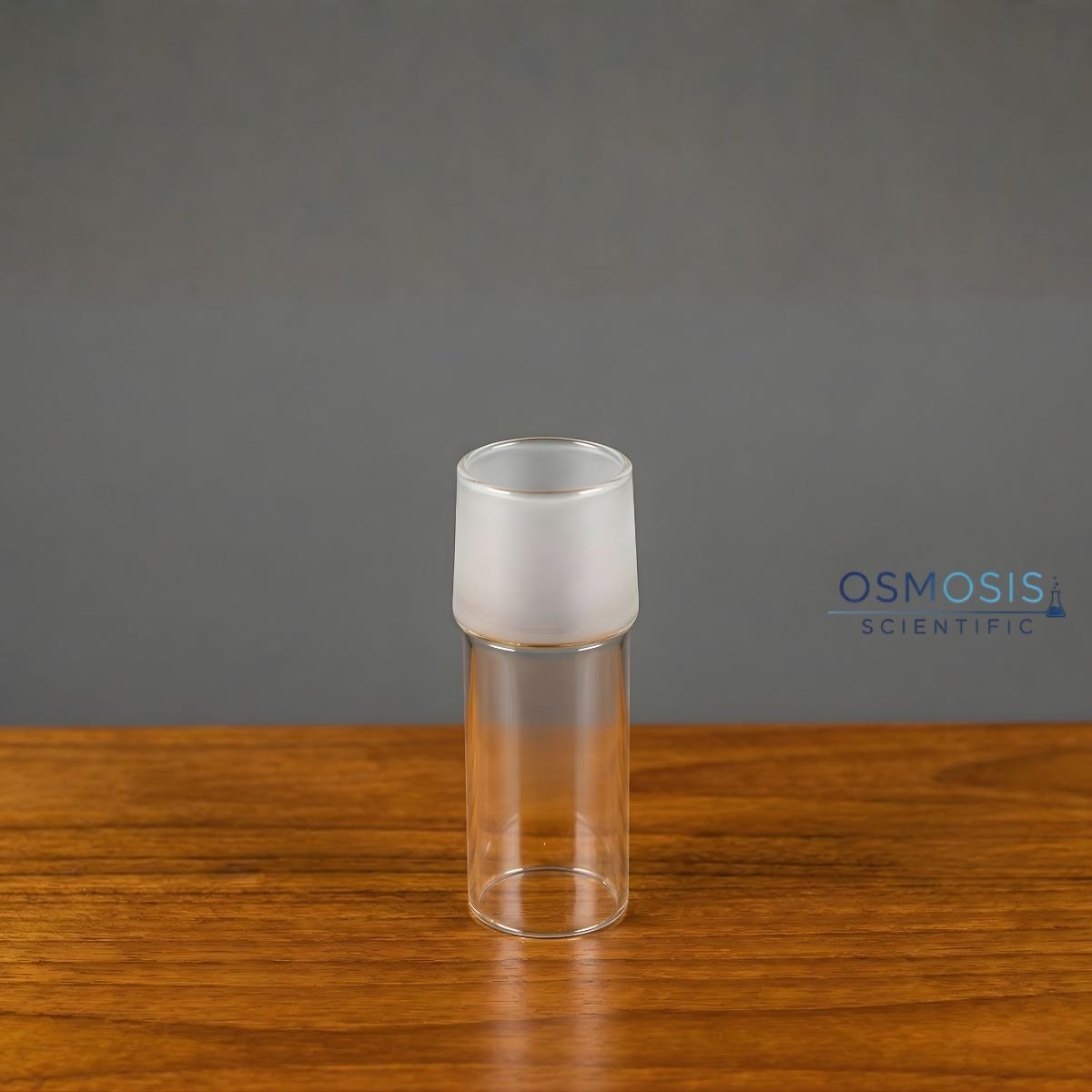


Description
The Unprinted Ground Glass Socket Joints from Osmosis Scientific are essential building blocks for the fabrication and repair of professional laboratory apparatus. These female “socket” joints are manufactured from high-quality Boro 3.3 borosilicate glass, offering the exceptional chemical inertness and thermal durability required for complex chemical reactions and distillations.
These joints are provided “unprinted” to allow for a clean, aesthetic finish when integrated into custom glassware by glass blowers. Each socket is precision-ground to an exact 1:10 internal taper, ensuring a seamless, leak-proof interface when paired with any ASTM-compliant male cone joint. This standardized design ensures that your custom setups remain interchangeable with standard laboratory components.
The robust, thick-walled construction of the Osmosis Scientific Socket Joint provides the mechanical strength necessary to withstand high-vacuum environments and the physical stresses of repeated assembly. Because they are made from ASTM E-438 Type 1 glass, they are perfectly suited for welding to borosilicate tubing, maintaining their structural integrity under the high temperatures required for glass blowing.
| Socket Size | Approx. O.D. of Tube (mm) | Total Length (mm) | Pack of | SKU | Enquiry |
|---|---|---|---|---|---|
| 10/30 | 13 | 120±10 | 10 | JSA-10_30 | Enquire Now |
| 12/30 | 16 | 120±10 | 10 | JSA-12_30 | Enquire Now |
| 14/35 | 18 | 120±10 | 10 | JSA-14_35 | Enquire Now |
| 19/38 | 22 | 125±10 | 10 | JSA-19_38 | Enquire Now |
| 24/40 | 28 | 135±15 | 10 | JSA-24_40 | Enquire Now |
| 29/42 | 32 | 135±15 | 10 | JSA-29_42 | Enquire Now |
| 34/35 | 38 | 150±15 | 10 | JSA-34_35 | Enquire Now |
| 45/40 | 50 | 150±15 | 10 | JSA-45_40 | Enquire Now |
Frequently Asked Questions (FAQs)
At Osmosis Scientific, our sockets are engineered to meet strict ASTM E676 quality standards, ensuring full interchangeability with any corresponding ASTM-compliant male cone. These sockets feature a finely ground inner surface that creates a high-vacuum seal when properly greased or used with PTFE sleeves. This precision is vital for maintaining pressure stability in titration, distillation, and reflux setups across pharmaceutical and industrial laboratories.
Printed markings or branding can sometimes harbor contaminants or degrade under extreme thermal stress. Osmosis Scientific provides unprinted ASTM sockets to eliminate these risks, which is crucial for sensitive experiments in organic synthesis and analytical chemistry. The transparent, unprinted finish also allows researchers to visually inspect the ground joint for “star cracks” or air pockets in the sealant, improving overall laboratory safety and equipment longevity.
While both systems use a 1:10 taper, American ASTM standards generally utilize a longer ground surface compared to the shorter ISO (DIN) lengths. For instance, an ASTM 24/40 socket is significantly longer than an ISO 24/29 socket. Osmosis Scientific manufactures a comprehensive range of ASTM sizes to ensure your North American-spec equipment maintains a secure, deep-set connection that won’t wobble or leak under vacuum pressure.
Maintaining your Osmosis Scientific sockets involves cleaning the ground surface thoroughly after each use to remove chemical residues. For high-vacuum work, a silicone or hydrocarbon-based grease is recommended to ensure airtight performance. If a joint does become stuck, do not apply excessive force; instead, use a controlled heat source to gently expand the outer socket or utilize specialized joint-separating tools to safely disconnect the components without breakage.
Reviews
There are no reviews yet.