

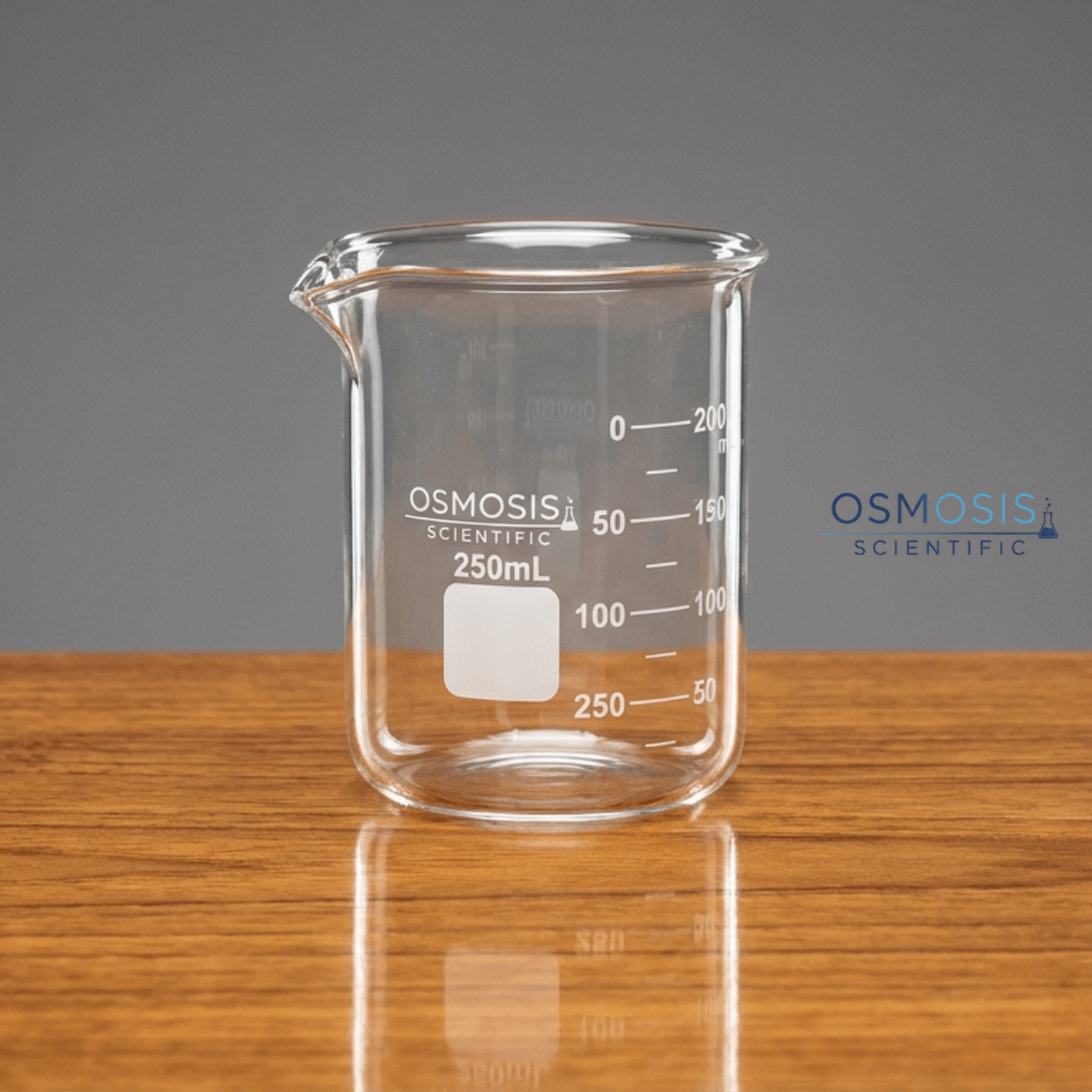


Description
| Capacity (mL) | Graduation Interval (mL) | Graduation Range (mL) | Pack of | SKU | Enquiry |
|---|---|---|---|---|---|
| 250 | 25 | 25 to 200 | 12 | GBHW-0250 | Enquire Now |
| 400 | 25 | 25 to 325 | 12 | GBHW-0400 | Enquire Now |
| 600 | 50 | 50 to 500 | 6 | GBHW-0600 | Enquire Now |
| 1000 | 50 | 50 to 1000 | 6 | GBHW-1000 | Enquire Now |
| 2000 | 100 | 200 to 1800 | 4 | GBHW-2000 | Enquire Now |
| 4000 | 250 | 250 to 3500 | 1 | GBHW-4000 | Enquire Now |
Frequently Asked Questions (FAQs)
What makes heavy-wall beakers different from standard-wall Griffin beakers?
Heavy-wall beakers feature thicker, reinforced glass construction designed specifically to withstand repeated mechanical stress from mechanized washing machines, more frequent autoclaving cycles, and harsh laboratory environments; standard beakers are optimized for occasional use.
What does ASTM E-960 Type I specify for heavy-duty beakers?
ASTM E-960 Type II (heavy-duty) specifies consistent dimensional requirements, wall thickness, thermal resistance, chemical resistance, and mechanical strength standards ensuring beakers perform reliably under harsh laboratory conditions.
What chemical resistance does borosilicate 3.3 glass provide?
Borosilicate 3.3 offers high chemical resistance to most mineral acids, bases, and organic solvents; however, avoid prolonged contact with strong alkaline solutions and hydrofluoric acid.
Are heavy-wall beakers worth the higher price investment?
Yes, for high-throughput labs, QC facilities, and research groups that perform frequent mechanized washing or sterilization, the durability and longevity of heavy-wall beakers justify the premium cost over standard-wall models.
Reviews
There are no reviews yet.