

Description
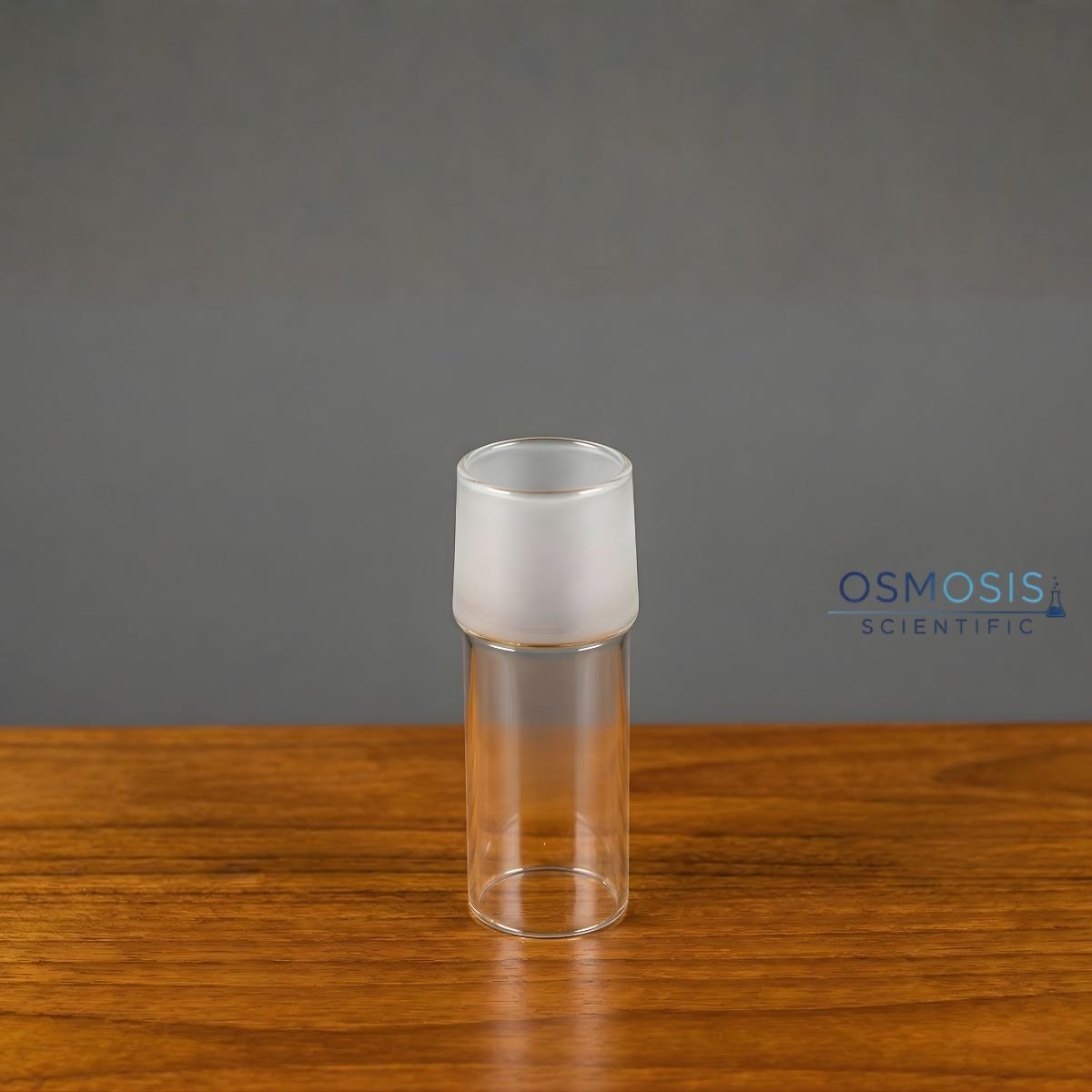
The Unprinted Glass Cone Joints from Osmosis Scientific are essential building blocks for scientific glassblowing and the development of custom laboratory systems. These male ground joints are crafted from premium Boro 3.3 borosilicate glass, ensuring the highest level of chemical inertness and thermal stability. The unprinted design is intentionally chosen to provide a clean, aesthetically professional finish that facilitates seamless welding into larger glass assemblies.
Every cone joint is precision-ground to a rigorous 1:10 taper, ensuring a perfect, leak-proof interface when paired with any standard DIN/ISO socket. This high-precision finish is critical for maintaining vacuum integrity in distillation setups, manifold systems, and complex reaction vessels. The uniform wall thickness of our joints provides the necessary mechanical strength to handle the physical rigors of daily laboratory assembly and disassembly.
Available in a comprehensive range of standard sizes—including 10/19, 12/21, 14/23, 19/26, 24/29, 29/32, 29/32, 34/35, 40/38, 45/40, 50/42, and 55/44—these joints allow for universal interchangeability across various laboratory brands and apparatus. Their superior thermal properties make them suitable for high-temperature reactions and rapid cooling cycles without compromising structural integrity.
| Socket Size | Approx. O.D. of Tube (mm) | Total Length (mm) | Pack of | SKU | Enquiry |
|---|---|---|---|---|---|
| 10/19 | 8 | 120±10 | 10 | JCD-10_19 | Enquire Now |
| 12/21 | 9 | 120±10 | 10 | JCD-12_21 | Enquire Now |
| 14/23 | 13 | 120±10 | 10 | JCD-14_23 | Enquire Now |
| 19/26 | 16 | 125±10 | 10 | JCD-19_26 | Enquire Now |
| 24/29 | 22 | 135±10 | 10 | JCD-24_29 | Enquire Now |
| 29/32 | 26 | 135±10 | 10 | JCD-29_32 | Enquire Now |
| 34/35 | 30 | 150±10 | 10 | JCD-34_35 | Enquire Now |
| 40/38 | 36 | 150±10 | 10 | JCD-40_38 | Enquire Now |
| 45/40 | 40 | 150±10 | 10 | JCD-45_40 | Enquire Now |
| 50/42 | 45 | 150±10 | 10 | JCD-50_42 | Enquire Now |
| 55/44 | 50 | 150±10 | 10 | JCD-55_44 | Enquire Now |
Frequently Asked Questions (FAQs)
- Cone (Male): The tapered, ground section that fits into another piece of glassware.
- Socket (Female): The receiving end that the cone fits into.
Yes. Because they are manufactured to DIN 12242 and ISO 383 standards, a cone from Osmosis Scientific will fit perfectly into a socket from any other manufacturer that follows the same metric standards.
Standard joints are defined by two numbers:
- The First Number (e.g., 24): This is the diameter (in mm) at the widest point of the ground section.
- The Second Number (e.g., 29): This is the length (in mm) of the ground surface.
The glass is precision-ground to a 1:10 taper. This exact angle ensures that when a cone and socket are joined, they create a continuous surface-to-surface contact that is airtight even under vacuum.
Joints can seize due to chemical attack or temperature changes. To prevent this:
- Use a light coating of vacuum grease (silicone or hydrocarbon-based).
- Use PTFE (Teflon) sleeves or rings for grease-free applications.
- Always clean the joints thoroughly after use to remove any residual chemicals.


Reviews
There are no reviews yet.