

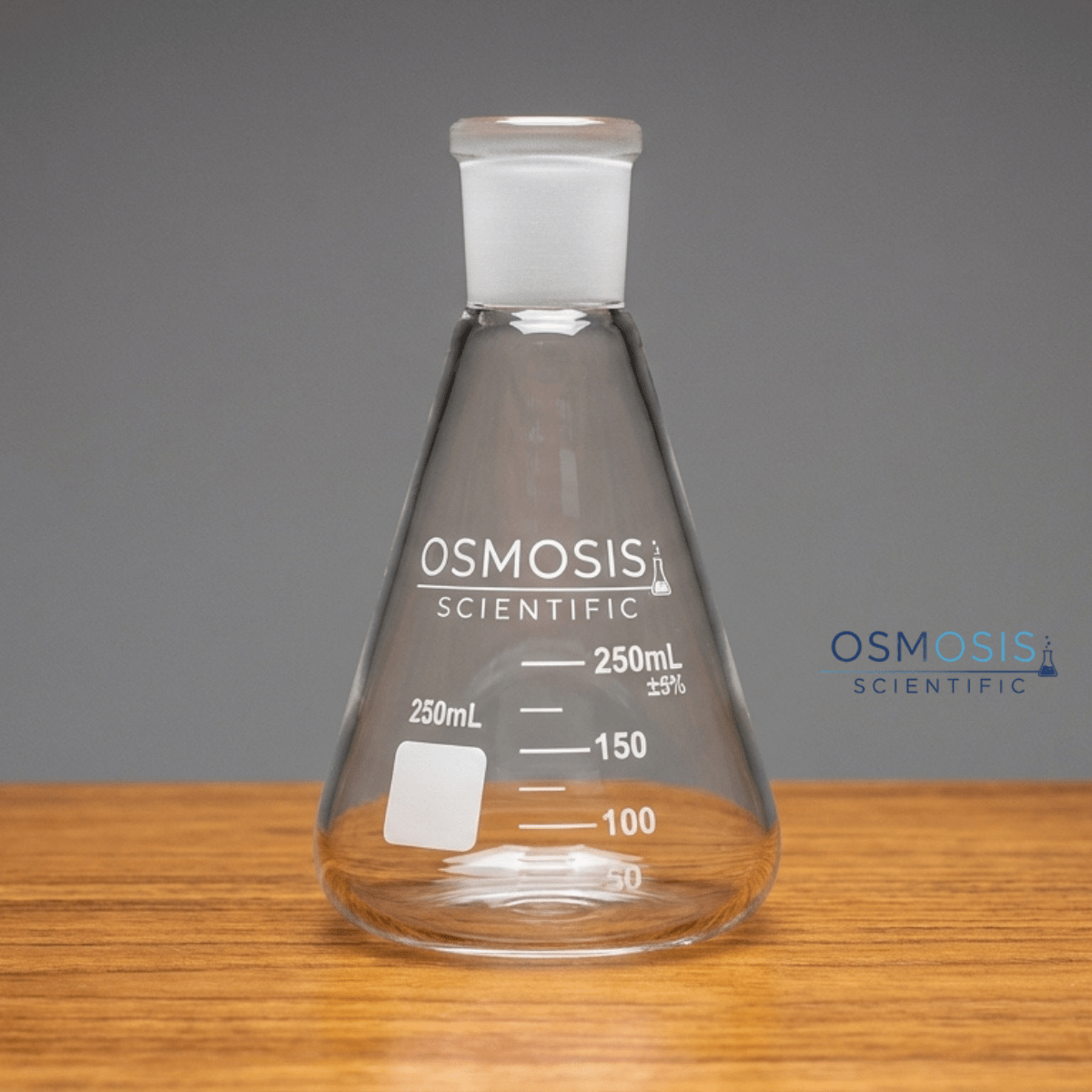



Description
| Capacity (mL) | Joint Size | Pack of | SKU | Enquiry |
|---|---|---|---|---|
| 10 | 14/20 | 2 | EFJ-0010-1420 | Enquire Now |
| 25 | 14/20 | 2 | EFJ-0025-1420 | Enquire Now |
| 50 | 14/20 | 2 | EFJ-0050-1420 | Enquire Now |
| 50 | 19/38 | 2 | EFJ-0050-1938 | Enquire Now |
| 50 | 24/40 | 2 | EFJ-0050-2440 | Enquire Now |
| 125 | 19/22 | 2 | EFJ-0125-1922 | Enquire Now |
| 125 | 24/40 | 2 | EFJ-0125-2440 | Enquire Now |
| 250 | 24/40 | 2 | EFJ-0250-2440 | Enquire Now |
| 300 | 24/40 | 2 | EFJ-0300-2440 | Enquire Now |
| 500 | 24/40 | 2 | EFJ-0500-2440 | Enquire Now |
| 1000 | 24/40 | 1 | EFJ-1000-2440 | Enquire Now |
| 2000 | 24/40 | 1 | EFJ-2000-2440 | Enquire Now |
Frequently Asked Questions (FAQs)
What is an Erlenmeyer flask with joint (ASTM standard)?
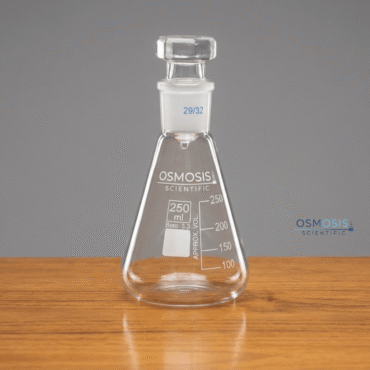
It’s a conical (Erlenmeyer) flask made to ASTM dimensional requirements and fitted with a standard taper ground glass joint for connecting to compatible lab glassware.
What is the advantage of a ground glass joint?
A standard ground joint provides a tight, leak‑resistant connection for assemblies such as adapters, condensers, addition funnels, and other jointed components.
What do joint sizes like 14/20 or 24/40 mean?
In standard taper joint labeling, the first number indicates the outer diameter (mm) at the top of the inner joint, and the second indicates the ground glass length (mm).
Are joints like 24/29 and 24/40 interchangeable?
They share the same taper and diameter, but the joint length differs (29 mm vs 40 mm), so compatibility can vary by setup and required engagement length.
Is this flask suitable for heating and reflux setups?
Yes—jointed Erlenmeyer flasks are commonly used in heated reactions and reflux assemblies when connected with compatible ground‑joint glassware.
Reviews
There are no reviews yet.