

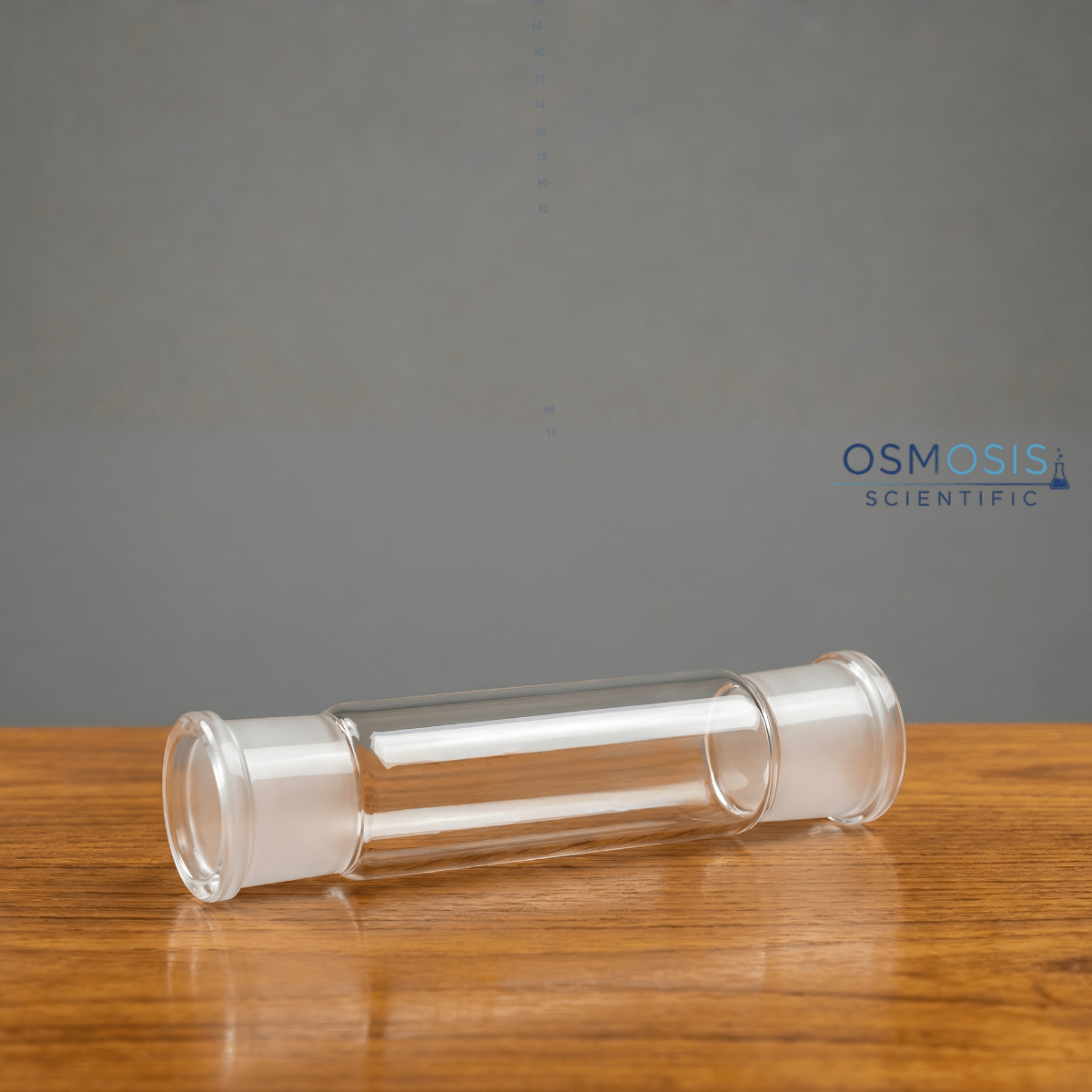


Description
The Double Socket Joint from Osmosis Scientific is a versatile connector engineered for maximum flexibility in laboratory glassware configurations. Designed to join two male (cone) joints, this adapter is an essential component for building complex distillation, extraction, or reaction systems. Each joint is crafted from premium Boro 3.3 borosilicate glass, providing the structural integrity and chemical inertness required for high-purity scientific applications.
Each socket is precision-ground to a standard 1:10 taper, ensuring universal compatibility with any DIN/ISO compliant glassware. The meticulous grinding process guarantees a tight, leak-proof interface, which is critical for maintaining vacuum conditions or preventing the escape of hazardous vapors during volatile reactions.
The double-socket design allows for streamlined transitions between different apparatus parts without the need for multiple intermediate adapters. With high thermal shock resistance, these joints are suitable for use in high-temperature procedures and can undergo repeated autoclaving or sterilization cycles without compromising the ground surface or glass clarity.
Note: For outsourced or specialized components, Osmosis Scientific acts as a supplier and distributor. Compliance with international standards is maintained through the original manufacturer’s protocols, who holds responsibility for primary certification. Osmosis Scientific shall not be held liable for glass breakage, joint seizing, or mechanical failure resulting from improper lubrication, thermal stress beyond rated limits, or use in over-pressurized systems.
| Socket Size | Approx. O.D. of Tube (mm) | Total Length (mm) | Pack of | SKU | Enquiry |
|---|---|---|---|---|---|
| 10/19 | 14 | 135±2 | 10 | JSDD-10_19 | Enquire Now |
| 14/23 | 18 | 135±2 | 10 | JSDD-14_23 | Enquire Now |
| 19/26 | 22 | 140±2 | 10 | JSDD-19_26 | Enquire Now |
| 24/29 | 28 | 170±5 | 10 | JSDD-24_29 | Enquire Now |
| 29/32 | 32 | 170±5 | 10 | JSDD-29_32 | Enquire Now |
| 34/35 | 38 | 180±5 | 10 | JSDD-34_35 | Enquire Now |
Frequently Asked Questions (FAQs)
Generally, yes. Most standard Double Socket joints are symmetrical (e.g., 10/19 on both ends). However, they can also function as “reducing” or “expanding” adapters if the two sockets are manufactured with different DIN sizes.
DIN refers to the German Institute for Standardization (Deutsches Institut für Normung). Our joints comply with DIN 12242, ensuring the taper is exactly 1:10. This guarantees that the joint is interchangeable with any other glassware meeting ISO or DIN standards.
Like all Osmosis Scientific glassware, these joints are manufactured from High-quality Borosilicate 3.3 glass. This provides:
- High Chemical Resistance: Essential for handling corrosive vapors.
- Thermal Stability: Prevents the glass from cracking under the heat of distillation.
- Vacuum Tightness: Precision grinding ensures a leak-proof seal.
Yes. To ensure a vacuum-tight seal and prevent the glass from “freezing,” a light film of vacuum grease or a PTFE sleeve should be used on the male cones before they are inserted into either side of the double socket.
Because the ground surface is on the inside of the tube, use a soft cylindrical brush and a mild laboratory detergent. Ensure no grease residue is left behind, as this can contaminate future reactions. They are fully autoclavable.
Standard double sockets are usually unprinted to maintain a clean aesthetic and prevent ink contamination, though size markings are sometimes etched into the glass for easy identification in busy laboratories.
Reviews
There are no reviews yet.