

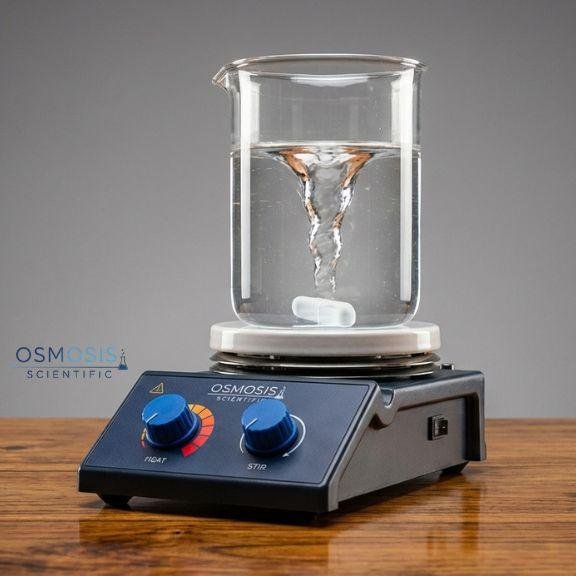
Description
| Parameter | Specification |
|---|---|
| Heating Plate Material | SS 304 grade with ceramic coating / Aluminium alloy with ceramic coating |
| Heating Plate Diameter | Ø145 mm (610DNAG) / Ø150 mm (710DNAG) |
| Stirring Speed Range | 50 – 1600 RPM |
| Maximum Stirring Bar Length | Up to 80 mm |
| Temperature Range | Ambient to approx. 350 °C |
| Overall Dimensions | 273 × 160 × 102 mm |
| Net Weight | 3.0 kg |
| Protection Class | IP22 |
| Voltage (Volts) | Frequency (Hz) | Power (Watts) | SKU | Enquiry |
|---|---|---|---|---|
| 230 | 50 | 650 | AMS-230-50-01 | Enquire Now |
| 230 | 50 | 650 | AMS-230-50-02 | Enquire Now |
| 115 | 60 | 650 | AMS-115-60-01 | Enquire Now |
| 115 | 60 | 650 | AMS-115-60-02 | Enquire Now |
| 115 | 60 | 650 | AMS-115-60-03 | Enquire Now |
Frequently Asked Questions (FAQs)
What is an Analogue Magnetic Stirrer With Hotplate?
It is a compact benchtop unit that combines controlled heating and magnetic stirring, allowing you to heat and mix lab solutions in one instrument instead of using separate hotplates and stirrers.
What applications is this hotplate stirrer suitable for?
Osmosis’s analogue hotplate stirrer is ideal for dissolving reagents, preparing buffers and media, heating reaction mixtures and keeping suspensions uniformly mixed in chemistry, pharma, QC and teaching labs.
What is the typical temperature and speed range?
Most analogue magnetic stirrers with hotplates operate from ambient temperature up to around 340–350 °C with a wide stirring speed range suitable for gentle mixing through vigorous agitation, matching common lab protocols.
What safety features should I expect on the Osmosis unit?
You should look for non‑slip chemical‑resistant top plates, over‑temperature protection, clear status indicators for heating and stirring, and a hot‑surface warning to reduce burn risk during routine use.
Can I use this hotplate stirrer with flammable solvents?
Yes, but only in a well‑ventilated area or fume hood, with appropriate glassware and controlled heating and speed settings, following your lab’s chemical safety guidelines to minimise ignition and spill risks.
How do I choose the right model capacity for my lab
Select an Osmosis model based on the maximum working volume of your typical beakers or flasks, ensuring the plate size supports your largest vessel and that the stated maximum stirring capacity covers your routine batch size.
Reviews
There are no reviews yet.