

Measuring Cylinders
Measuring Cylinders — Precision Volumetric Laboratory Glassware & Plasticware
Measuring cylinders are semi‑precise volumetric instruments designed to measure variable liquid volumes quickly and reliably in everyday lab work. At Osmosis Scientific, our measuring cylinders combine robust materials, clear graduations, and standards‑driven metrology so you can trust every reading, from teaching labs to regulated QC environments.
What is a Measuring Cylinder? & Technical Specs
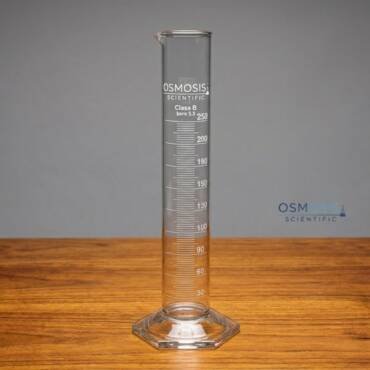
A measuring cylinder (or graduated cylinder) is a tall, narrow vessel calibrated to indicate the volume of liquids with higher accuracy than beakers, while staying more flexible than single‑volume flasks. Osmosis Scientific measuring cylinders are designed to support highly accurate volume measurement when used with proper technique.
Key specifications include:
- Calibration: Available in Class A or Class B, typically calibrated at 20°C, “To Contain” (TC) unless stated otherwise.
- Compliance: Designed to meet relevant ISO 4788 and/or ASTM E1272 requirements for capacity and tolerance.
- Capacities: Broad ranges from 5 mL to 2000 mL and higher, featuring fine graduation intervals for small volumes.
- Scale: High‑contrast, chemically resistant graduations designed for long‑term legibility.
Manufacturing Quality & Key Features
Osmosis Scientific prioritizes material integrity and dimensional stability. Our in-house glass cylinders are manufactured from low‑expansion Borosilicate 3.3 glass for excellent thermal shock resistance and minimal volume drift. We also source premium plastic options (such as PP or PMP) from trusted third-party manufacturers, chosen for their balance of clarity, break‑resistance, and chemical compatibility.
Design highlights include:
- Stable hexagonal or wide bases to reduce tipping.
- Drip‑free spouts engineered for controlled pouring.
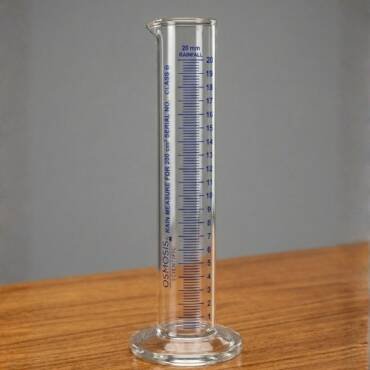
- Sharp, evenly spaced graduations to support confident visual interpolation.
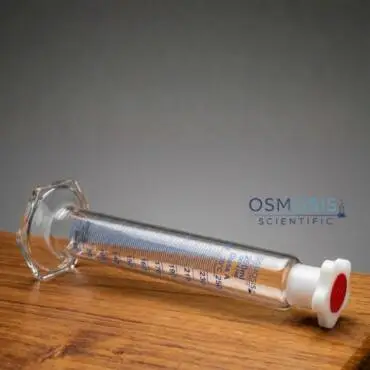
- Large marking spots for sample ID and optional stoppers for short‑term storage.
Applications in Precision Chemistry
Measuring cylinders are widely used wherever moderate‑accuracy liquid measurement is required. Typical applications include:
- Reagent and solvent measurement across chemistry and biology.
- Buffer and media preparation, density, and displacement experiments.
- Routine QC checks and sample dilutions in pharmaceutical and food‑and‑beverage labs.
- Volumetric pre‑measuring before transferring liquids to high-precision flasks, pipettes, or burettes.
System & Instrument Compatibility
Our measuring cylinders are designed to integrate smoothly with common laboratory setups. Their geometries fit typical fume hoods, laminar cabinets, and benchtop stands, while their bases are sized for standard hotplates and magnetic stirrer platforms when gentle mixing is required.
For analytical procedures involving solutions that would etch glass (such as Hydrofluoric acid/HF), our sourced plastic cylinders offer the specialized material compatibility your workflows demand.
Calibration, Traceability & Certification
Where applicable, Osmosis Scientific offers Class A measuring cylinders manufactured to support traceable calibration against international volumetric standards. These models are designed to support laboratories implementing ISO‑based quality systems or routine gravimetric checks using distilled water and analytical balances.
(Note: Certain specialized or plastic products are sourced from qualified third-party manufacturers. For outsourced certified products, certification validity, calibration accuracy, and traceability remain the sole responsibility of the original manufacturer or issuing certification body.)
Handling, Storage & Safe Operation
Correct handling is essential to maintain user safety and volumetric performance. Cylinders should be placed on a level surface, with the meniscus viewed exactly at eye level to minimize parallax error.
Avoid sudden temperature shocks, abrasive cleaning tools, or prolonged exposure to aggressive chemicals outside the material’s compatibility range.
Osmosis Scientific shall not be held liable for:
- Calibration deviations caused by physical damage, wear, improper cleaning, or thermal exposure after delivery.
- Improper handling, misuse, or certification interpretation outside intended laboratory conditions.
Why Global Buyers Choose Osmosis Scientific
Laboratories and distributors choose Osmosis Scientific for a balanced combination of material quality, standards‑aligned tolerances, and practical design.
- Curated range covering glass and plastic, Class A and Class B.
- Clear product data and export‑ready documentation.
- Secure packaging suitable for domestic and international shipping.
- Positioned to support bulk procurement and OEM branding for teaching institutes, industrial plants, and accredited testing laboratories.
Showing all 3 results

Measuring Cylinders — Precision Volumetric Laboratory Glassware & Plasticware
Measuring cylinders are semi‑precise volumetric instruments designed to measure variable liquid volumes quickly and reliably in everyday lab work. At Osmosis Scientific, our measuring cylinders combine robust materials, clear graduations, and standards‑driven metrology so you can trust every reading, from teaching labs to regulated QC environments.
What is a Measuring Cylinder? & Technical Specs
A measuring cylinder (or graduated cylinder) is a tall, narrow vessel calibrated to indicate the volume of liquids with higher accuracy than beakers, while staying more flexible than single‑volume flasks. Osmosis Scientific measuring cylinders are designed to support highly accurate volume measurement when used with proper technique.
Key specifications include:
- Calibration: Available in Class A or Class B, typically calibrated at 20°C, "To Contain" (TC) unless stated otherwise.
- Compliance: Designed to meet relevant ISO 4788 and/or ASTM E1272 requirements for capacity and tolerance.
- Capacities: Broad ranges from 5 mL to 2000 mL and higher, featuring fine graduation intervals for small volumes.
- Scale: High‑contrast, chemically resistant graduations designed for long‑term legibility.
Manufacturing Quality & Key Features
Osmosis Scientific prioritizes material integrity and dimensional stability. Our in-house glass cylinders are manufactured from low‑expansion Borosilicate 3.3 glass for excellent thermal shock resistance and minimal volume drift. We also source premium plastic options (such as PP or PMP) from trusted third-party manufacturers, chosen for their balance of clarity, break‑resistance, and chemical compatibility.
Design highlights include:
- Stable hexagonal or wide bases to reduce tipping.
- Drip‑free spouts engineered for controlled pouring.
- Sharp, evenly spaced graduations to support confident visual interpolation.
- Large marking spots for sample ID and optional stoppers for short‑term storage.
Applications in Precision Chemistry
Measuring cylinders are widely used wherever moderate‑accuracy liquid measurement is required. Typical applications include:
- Reagent and solvent measurement across chemistry and biology.
- Buffer and media preparation, density, and displacement experiments.
- Routine QC checks and sample dilutions in pharmaceutical and food‑and‑beverage labs.
- Volumetric pre‑measuring before transferring liquids to high-precision flasks, pipettes, or burettes.
System & Instrument Compatibility
Our measuring cylinders are designed to integrate smoothly with common laboratory setups. Their geometries fit typical fume hoods, laminar cabinets, and benchtop stands, while their bases are sized for standard hotplates and magnetic stirrer platforms when gentle mixing is required.
For analytical procedures involving solutions that would etch glass (such as Hydrofluoric acid/HF), our sourced plastic cylinders offer the specialized material compatibility your workflows demand.
Calibration, Traceability & Certification
Where applicable, Osmosis Scientific offers Class A measuring cylinders manufactured to support traceable calibration against international volumetric standards. These models are designed to support laboratories implementing ISO‑based quality systems or routine gravimetric checks using distilled water and analytical balances.
(Note: Certain specialized or plastic products are sourced from qualified third-party manufacturers. For outsourced certified products, certification validity, calibration accuracy, and traceability remain the sole responsibility of the original manufacturer or issuing certification body.)
Handling, Storage & Safe Operation
Correct handling is essential to maintain user safety and volumetric performance. Cylinders should be placed on a level surface, with the meniscus viewed exactly at eye level to minimize parallax error.
Avoid sudden temperature shocks, abrasive cleaning tools, or prolonged exposure to aggressive chemicals outside the material’s compatibility range.
Osmosis Scientific shall not be held liable for:
- Calibration deviations caused by physical damage, wear, improper cleaning, or thermal exposure after delivery.
- Improper handling, misuse, or certification interpretation outside intended laboratory conditions.
Why Global Buyers Choose Osmosis Scientific
Laboratories and distributors choose Osmosis Scientific for a balanced combination of material quality, standards‑aligned tolerances, and practical design.
- Curated range covering glass and plastic, Class A and Class B.
- Clear product data and export‑ready documentation.
- Secure packaging suitable for domestic and international shipping.
- Positioned to support bulk procurement and OEM branding for teaching institutes, industrial plants, and accredited testing laboratories.
Frequently Asked Questions
Do you offer both glass and plastic measuring cylinders?
Yes, Osmosis Scientific manufactures measuring cylinders from high-quality Borosilicate 3.3 glass for superior thermal and chemical resistance, and also supplies premium plastic options (such as PP and PMP) from trusted partners for environments requiring break-resistance or specific chemical compatibility, like HF acid.
What standards do Osmosis Scientific measuring cylinders comply with?
Our measuring cylinders are designed to meet relevant international metrology standards, including ISO 4788 and ASTM E1272 requirements for capacity and tolerance, supporting highly reliable performance in regulated laboratories.
Are measuring cylinders as accurate as volumetric flasks?
No, measuring cylinders are semi-precise instruments designed for general volume measurement and rapid liquid transfer. For applications requiring exact, predefined volume preparation and the highest analytical precision, volumetric glassware with a single calibration mark, such as a volumetric flask, should be used.
How should a measuring cylinder be handled to maintain calibration?
Cylinders should be read at eye level on a stable surface. Avoid subjecting them to sudden temperature shocks or abrasive cleaning. Osmosis Scientific shall not be held liable for calibration deviations caused by physical damage, wear, thermal exposure, or improper cleaning after delivery.