

Erlenmeyer Conical Flask
Erlenmeyer Conical Flasks — Precision Borosilicate Glassware
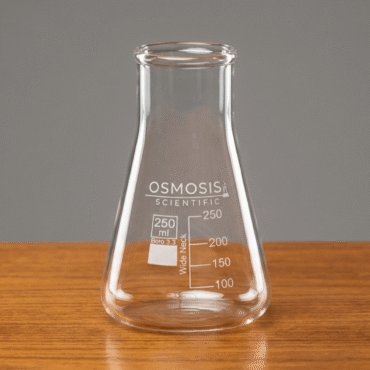
The Erlenmeyer (conical) flask is a versatile laboratory vessel with a wide, flat base and narrow neck, designed for safe mixing, heating, and handling of liquids with minimal risk of spillage or evaporation. Manufactured from chemically resistant Borosilicate 3.3 glass, it is a core instrument in titration, culturing, and general solution preparation workflows across teaching laboratories, research facilities, and industrial production environments.
Design and Construction
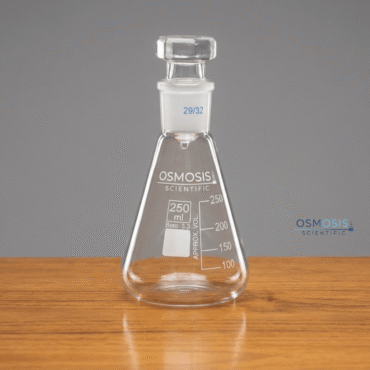
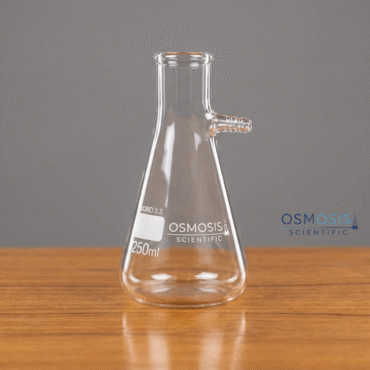
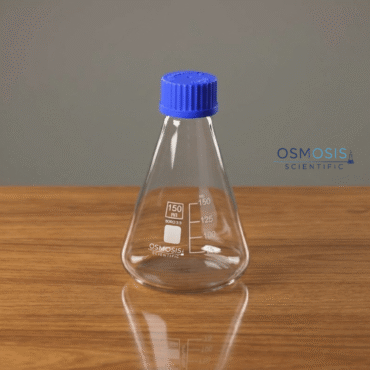
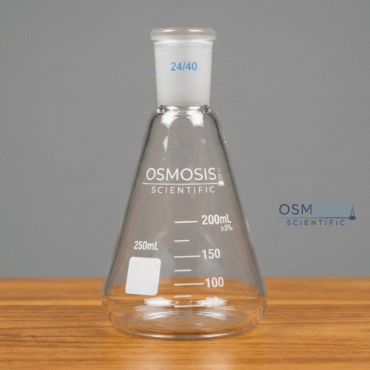
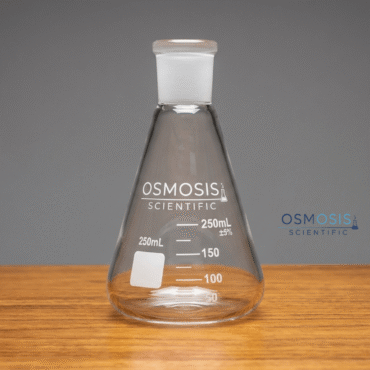
The Erlenmeyer flask features a broad, stable base, sloping conical walls, and a cylindrical neck that may remain open, be stoppered, or be connected to laboratory accessories. This geometry enables vigorous swirling without splashing, reduces tipping risk, and allows secure clamping during heating or shaking.
High-quality Erlenmeyer flasks are manufactured from low-expansion Borosilicate 3.3 glass, offering:
- Thermal Performance: Strong resistance to thermal shock, suitable for routine heating and boiling applications.
- Chemical Durability: High resistance to most laboratory acids, bases, and solvents.
- Structural Integrity: Uniform wall thickness with reinforced, beaded rims to improve mechanical strength.
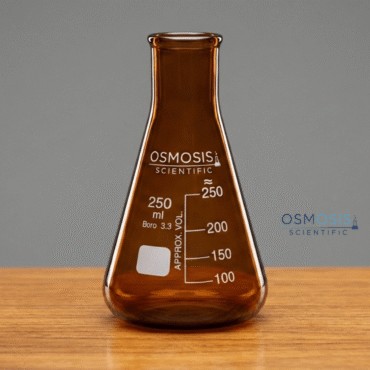
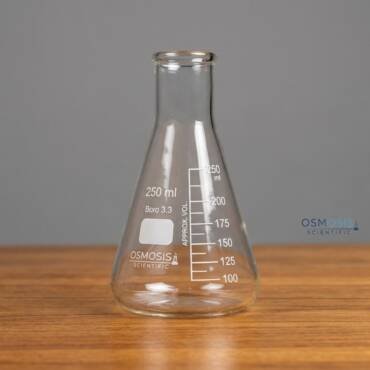
- Visual Clarity: Permanent white enamel graduations for approximate volume reference and a dedicated marking area for sample identification.
Key Applications in the Laboratory
While graduations provide approximate volume guidance, Erlenmeyer flasks are intended for process efficiency rather than primary analytical measurement.
- Titration: Commonly used as the receiving vessel under a burette. The conical design supports smooth swirling during titrant addition without splashing or sample loss.
- Solution Preparation and Mixing: Ideal for dissolving solids and mixing reagents manually with improved splash control compared to straight-sided beakers.
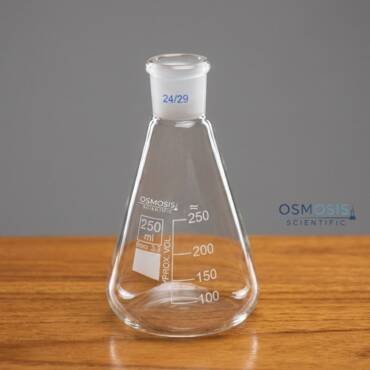
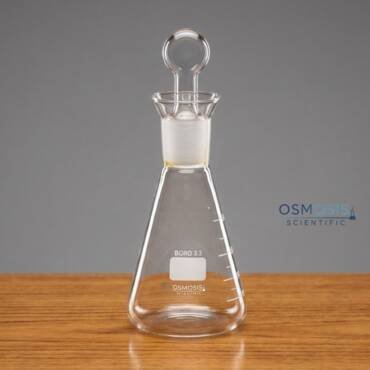
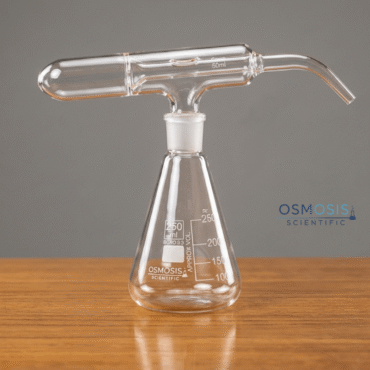
- Heating and Reflux: Suitable for gentle boiling on hotplates. Narrow-neck versions can be connected to condensers or stoppers for distillation and reflux setups.
- Microbiology and Cell Culture: Long-neck variants can accommodate cotton plugs or specialized caps, enabling aerated culture growth while reducing contamination risk.
Advantages in Daily Laboratory Use
The conical geometry provides several practical benefits:
- Stability: The wide base minimizes tipping compared to narrow-bottom vessels.
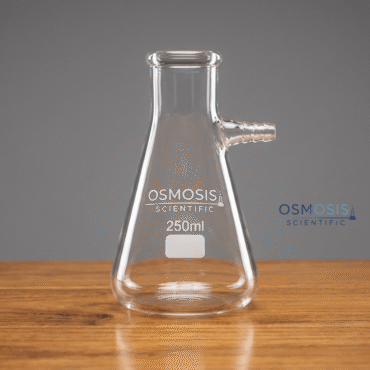
- Evaporation Control: The narrow neck reduces vapor loss and improves control when adding reagents or attaching tubing.
- Efficient Mixing: Manual swirling is fast, efficient, and often preferable to mechanical stirring for routine laboratory tasks.
System and Instrument Compatibility
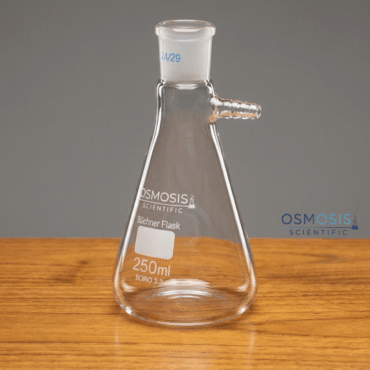
Osmosis Scientific conical flasks are designed for compatibility with standard laboratory equipment. Flat bottoms provide effective surface contact for heat transfer when used with digital hotplate magnetic stirrers. Neck dimensions accommodate standard ISO/DIN stopper sizes and laboratory clamps for secure positioning in distillation, reflux, or shaking assemblies.
Handling, Storage, and Safe Operation
To maximize service life and maintain laboratory safety, inspect flasks for chips, cracks, or surface damage before heating.
- Cleaning: Rinse residues promptly, clean with laboratory-grade detergent using a soft brush, and rinse thoroughly with deionized water before drying.
- Thermal Safety: Avoid sudden temperature changes, such as placing a hot flask on a cold surface, to prevent thermal shock.
- Liability Notice: Osmosis Scientific shall not be held liable for structural failure, breakage, or performance deviations caused by improper handling, cleaning, or thermal exposure after delivery.
Showing all 13 results
Erlenmeyer Conical Flasks — Precision Borosilicate Glassware
The Erlenmeyer (conical) flask is a versatile laboratory vessel with a wide, flat base and narrow neck, designed for safe mixing, heating, and handling of liquids with minimal risk of spillage or evaporation. Manufactured from chemically resistant Borosilicate 3.3 glass, it is a core instrument in titration, culturing, and general solution preparation workflows across teaching laboratories, research facilities, and industrial production environments.
Design and Construction
The Erlenmeyer flask features a broad, stable base, sloping conical walls, and a cylindrical neck that may remain open, be stoppered, or be connected to laboratory accessories. This geometry enables vigorous swirling without splashing, reduces tipping risk, and allows secure clamping during heating or shaking.
High-quality Erlenmeyer flasks are manufactured from low-expansion Borosilicate 3.3 glass, offering:
- Thermal Performance: Strong resistance to thermal shock, suitable for routine heating and boiling applications.
- Chemical Durability: High resistance to most laboratory acids, bases, and solvents.
- Structural Integrity: Uniform wall thickness with reinforced, beaded rims to improve mechanical strength.
- Visual Clarity: Permanent white enamel graduations for approximate volume reference and a dedicated marking area for sample identification.
Key Applications in the Laboratory
While graduations provide approximate volume guidance, Erlenmeyer flasks are intended for process efficiency rather than primary analytical measurement.
- Titration: Commonly used as the receiving vessel under a burette. The conical design supports smooth swirling during titrant addition without splashing or sample loss.
- Solution Preparation and Mixing: Ideal for dissolving solids and mixing reagents manually with improved splash control compared to straight-sided beakers.
- Heating and Reflux: Suitable for gentle boiling on hotplates. Narrow-neck versions can be connected to condensers or stoppers for distillation and reflux setups.
- Microbiology and Cell Culture: Long-neck variants can accommodate cotton plugs or specialized caps, enabling aerated culture growth while reducing contamination risk.
Advantages in Daily Laboratory Use
The conical geometry provides several practical benefits:
- Stability: The wide base minimizes tipping compared to narrow-bottom vessels.
- Evaporation Control: The narrow neck reduces vapor loss and improves control when adding reagents or attaching tubing.
- Efficient Mixing: Manual swirling is fast, efficient, and often preferable to mechanical stirring for routine laboratory tasks.
System and Instrument Compatibility
Osmosis Scientific conical flasks are designed for compatibility with standard laboratory equipment. Flat bottoms provide effective surface contact for heat transfer when used with digital hotplate magnetic stirrers. Neck dimensions accommodate standard ISO/DIN stopper sizes and laboratory clamps for secure positioning in distillation, reflux, or shaking assemblies.
Handling, Storage, and Safe Operation
To maximize service life and maintain laboratory safety, inspect flasks for chips, cracks, or surface damage before heating.
- Cleaning: Rinse residues promptly, clean with laboratory-grade detergent using a soft brush, and rinse thoroughly with deionized water before drying.
- Thermal Safety: Avoid sudden temperature changes, such as placing a hot flask on a cold surface, to prevent thermal shock.
- Liability Notice: Osmosis Scientific shall not be held liable for structural failure, breakage, or performance deviations caused by improper handling, cleaning, or thermal exposure after delivery.
Erlenmeyer Conical Flask FAQs
What is an Erlenmeyer (conical) flask used for?
An Erlenmeyer flask is used for mixing, heating, and holding liquids. Its unique conical shape allows for vigorous swirling without splashing, making it the standard choice for titrations and culture preparation.
Why is a conical flask preferred in titration instead of a beaker?
The narrow neck prevents spillage and evaporation while swirling, ensuring all reactants stay inside the vessel. This provides better control and visibility when reaching the titration endpoint.
Can these flasks be used for accurate volume measurement?
No. Graduations on Erlenmeyer flasks are for approximate estimation (±5%). For high-precision analytical work, we recommend using Osmosis Scientific Class A Volumetric Flasks.