

Beaker
Laboratory Beakers — Precision Borosilicate Glassware & Plasticware
Laboratory beakers are the everyday vessels of the lab, used for mixing, heating, and roughly measuring liquids in everything from teaching experiments to industrial QC. Osmosis Scientific laboratory beakers are designed to support reliable, routine work with rugged construction, clear markings, and sizes that fit seamlessly into standard workflows.
What is a Laboratory Beaker? & Technical Specs
A laboratory beaker is a straight-sided, flat-bottomed container with a pouring lip, intended for holding, mixing, and heating liquids and for approximate volume estimation. Osmosis Scientific beakers are designed to support accurate visual handling of liquids while remaining durable enough for daily use on hotplates. Typical specifications include:
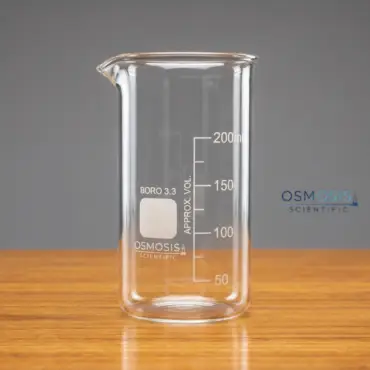
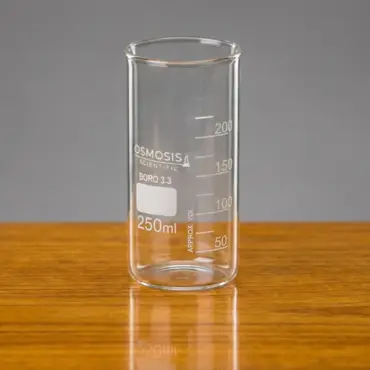
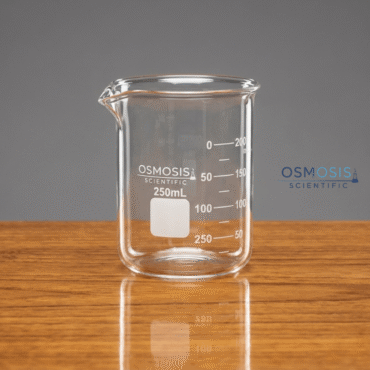
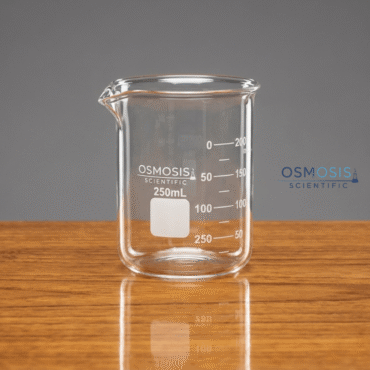
- Forms: Low-form (Griffin) beakers for general use; tall-form (Berzelius) beakers for reduced evaporation and better use under condensers.
- Material: Borosilicate 3.3 glass for high thermal shock resistance and chemical durability; selected plastic variants for impact-resistant environments.
- Capacities: Common sizes from micro-scale 5 mL up to several liters for bulk solution prep.
- Scale: Approximate volume graduations designed for visual reference, not primary analytical measurement.
Manufacturing Quality & Key Features
Osmosis Scientific glass beakers utilize low-expansion Borosilicate 3.3 glass for reliable performance during repeated heating and cooling cycles.
- Structural Integrity: Uniform wall thickness and reinforced rims help resist mechanical shock.
- Controlled Pouring: Precision-molded spouts provide clean decanting into flasks, cylinders, or funnels.
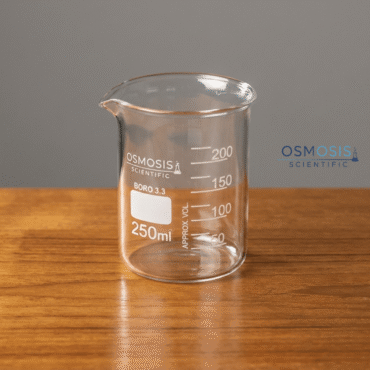
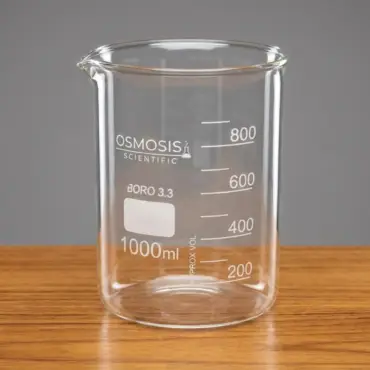
- Clear Identification: High-contrast, chemically resistant graduations and large marking spots allow for easy sample labeling.
- Plastic Options: Sourced plastic variants are chosen for robustness and chemical compatibility in educational or field environments where glass breakage risk is high.
Applications in Precision Chemistry
While not primary volumetric instruments, beakers are indispensable in almost every laboratory process. Typical applications include:
- Reagent preparation, buffer mixing, and heating solutions.
- Capturing filtrates and performing preliminary reactions.
- Staging liquids before transfer into volumetric flasks, cylinders, or burettes.
- Safe observation of dissolving, precipitation, and temperature changes in teaching labs.
System & Instrument Compatibility
Osmosis beakers are dimensioned to work seamlessly with standard hotplates, magnetic stirrers, clamps, and support stands used worldwide. Their flat bottoms provide optimal contact for heat transfer, while tall-form variants fit comfortably under condensers in reflux or distillation setups. Beaker capacities are matched to common volumes used in volumetric flasks and pipettes, making it easy to scale recipes between preparation and measurement stages.
Calibration, Traceability & Certification
Graduations on Osmosis Scientific laboratory beakers are intended for approximate volume indication and process convenience. For calibrated, traceable volume measurement, we recommend pairing beakers with our Class A or Class B volumetric instruments that align with ISO and ASTM standards. For outsourced certified volumetric products or plasticware within the Osmosis range, certification validity, calibration accuracy, and traceability remain the sole responsibility of the original manufacturer or issuing certification body.
Handling, Storage & Safe Operation
To maximize service life, glass beakers should be heated gradually. Never expose them to sudden temperature swings, such as placing hot glass directly onto cold surfaces. Avoid open flame contact with plastic variants and respect each material’s specific temperature limits. Osmosis Scientific shall not be held liable for:
- Performance deviations or structural failure caused by breakage, improper cleaning, or thermal exposure after delivery.
- Improper handling, misuse, or application of heat outside the material compatibility range.
Why Global Buyers Choose Osmosis Scientific Beakers
Buyers choose Osmosis Scientific for dependable material quality and the ability to standardize across R&D and industrial environments with one coherent range. With export-ready packaging and clear specifications, we support distributors looking to build complete, interoperable glassware systems that are easy to stock and easy to work with every day.
Showing all 6 results
Laboratory Beakers — Precision Borosilicate Glassware & Plasticware
Laboratory beakers are the everyday vessels of the lab, used for mixing, heating, and roughly measuring liquids in everything from teaching experiments to industrial QC. Osmosis Scientific laboratory beakers are designed to support reliable, routine work with rugged construction, clear markings, and sizes that fit seamlessly into standard workflows.
What is a Laboratory Beaker? & Technical Specs
A laboratory beaker is a straight-sided, flat-bottomed container with a pouring lip, intended for holding, mixing, and heating liquids and for approximate volume estimation. Osmosis Scientific beakers are designed to support accurate visual handling of liquids while remaining durable enough for daily use on hotplates. Typical specifications include:
- Forms: Low-form (Griffin) beakers for general use; tall-form (Berzelius) beakers for reduced evaporation and better use under condensers.
- Material: Borosilicate 3.3 glass for high thermal shock resistance and chemical durability; selected plastic variants for impact-resistant environments.
- Capacities: Common sizes from micro-scale 5 mL up to several liters for bulk solution prep.
- Scale: Approximate volume graduations designed for visual reference, not primary analytical measurement.
Manufacturing Quality & Key Features
Osmosis Scientific glass beakers utilize low-expansion Borosilicate 3.3 glass for reliable performance during repeated heating and cooling cycles.
- Structural Integrity: Uniform wall thickness and reinforced rims help resist mechanical shock.
- Controlled Pouring: Precision-molded spouts provide clean decanting into flasks, cylinders, or funnels.
- Clear Identification: High-contrast, chemically resistant graduations and large marking spots allow for easy sample labeling.
- Plastic Options: Sourced plastic variants are chosen for robustness and chemical compatibility in educational or field environments where glass breakage risk is high.
Applications in Precision Chemistry
While not primary volumetric instruments, beakers are indispensable in almost every laboratory process. Typical applications include:
- Reagent preparation, buffer mixing, and heating solutions.
- Capturing filtrates and performing preliminary reactions.
- Staging liquids before transfer into volumetric flasks, cylinders, or burettes.
- Safe observation of dissolving, precipitation, and temperature changes in teaching labs.
System & Instrument Compatibility
Osmosis beakers are dimensioned to work seamlessly with standard hotplates, magnetic stirrers, clamps, and support stands used worldwide. Their flat bottoms provide optimal contact for heat transfer, while tall-form variants fit comfortably under condensers in reflux or distillation setups. Beaker capacities are matched to common volumes used in volumetric flasks and pipettes, making it easy to scale recipes between preparation and measurement stages.
Calibration, Traceability & Certification
Graduations on Osmosis Scientific laboratory beakers are intended for approximate volume indication and process convenience. For calibrated, traceable volume measurement, we recommend pairing beakers with our Class A or Class B volumetric instruments that align with ISO and ASTM standards. For outsourced certified volumetric products or plasticware within the Osmosis range, certification validity, calibration accuracy, and traceability remain the sole responsibility of the original manufacturer or issuing certification body.
Handling, Storage & Safe Operation
To maximize service life, glass beakers should be heated gradually. Never expose them to sudden temperature swings, such as placing hot glass directly onto cold surfaces. Avoid open flame contact with plastic variants and respect each material’s specific temperature limits. Osmosis Scientific shall not be held liable for:
- Performance deviations or structural failure caused by breakage, improper cleaning, or thermal exposure after delivery.
- Improper handling, misuse, or application of heat outside the material compatibility range.
Why Global Buyers Choose Osmosis Scientific Beakers
Buyers choose Osmosis Scientific for dependable material quality and the ability to standardize across R&D and industrial environments with one coherent range. With export-ready packaging and clear specifications, we support distributors looking to build complete, interoperable glassware systems that are easy to stock and easy to work with every day.
Frequently Asked Questions
Are Osmosis laboratory beakers accurate enough for measurements?
Osmosis beakers have clear graduations for approximate volume estimates, but critical measurements should be done with calibrated volumetric flasks, cylinders or burettes.
Can I heat Osmosis glass beakers directly on a hotplate or burner?
Yes, our borosilicate 3.3 glass beakers are designed to withstand typical lab heating on hotplates or over burners when temperature is increased gradually and thermal shock is avoided.
What’s the difference between low-form (Griffin) and tall-form beakers?
Low-form beakers are shorter and wider for general mixing and heating, while tall-form beakers are slimmer, reduce evaporation and fit better under condensers or in specific setups.
Do Osmosis beakers come in plastic as well as glass?
Yes, alongside borosilicate glass options we offer selected plastic beakers for teaching, field and industrial use where impact resistance and light weight are priorities.
How should I clean and store Osmosis laboratory beakers?
Use mild lab detergent with non-abrasive brushes, rinse thoroughly and dry on stable racks; avoid abrasive pads or harsh, incompatible chemicals that can damage surfaces and graduations.