Skip to content Skip to footer
+91 9350081403
Street No. 7, Preet Nagar, Ambala Cantt, Haryana – 133001
+91-9350081403

Info@osmosisscientific.com

Laboratory Glassware

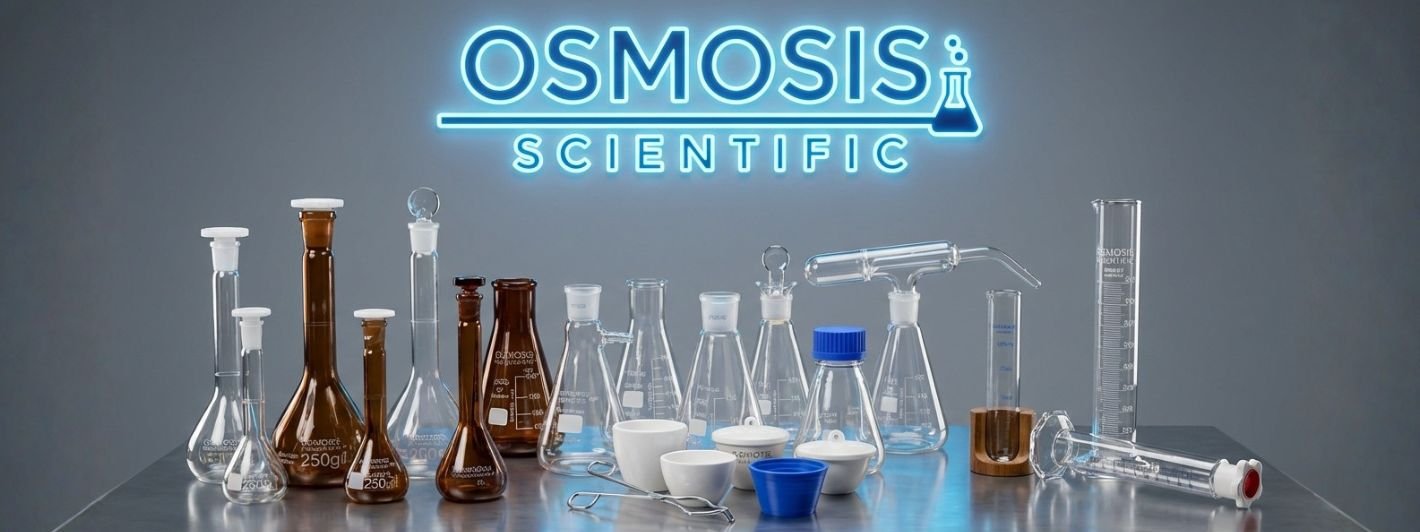
Laboratory Glassware Complete range from Osmosis Scientific

Laboratory glassware is the backbone of repeatable scientific outcomes—facilitating everything from basic reagent mixing to high-accuracy volumetric analysis. At Laboratory glassware is the backbone of repeatable scientific outcomes—facilitating everything from basic reagent mixing to high-accuracy volumetric analysis. At Osmosis Scientific, we manufacture and supply glassware designed to meet the rigorous demands of teaching labs, R&D facilities, and industrial QC environments, prioritizing optical clarity, superior chemical durability, and thermal stability., we manufacture and supply glassware designed to meet the rigorous demands of teaching labs, R&D facilities, and industrial QC environments, prioritizing optical clarity, superior chemical durability, and thermal stability.

Material Science: Choosing the Right Glass Type

  • Borosilicate 3.3 (Type I, Class A): The industry standard for heating and chemical reactions. With a low coefficient of linear expansion (3.3 × 10⁻⁶ K-1), it offers maximum resistance to thermal shock and is virtually inert to most acids and alkaline solutions.
  • Soda-Lime Glass (Type III): Best suited for low-stress applications such as disposable culture tubes or general storage where thermal fluctuations are minimal.
  • Quartz (Fused Silica): Reserved for specialized high-temperature applications (>1000°C) or UV-visible spectroscopy where extreme optical purity is required.
  • Safety Note: Using soda-lime glass for direct heating is a major safety risk. Always verify that your beakers and flasks are marked as Borosilicate 3.3 before placing them on a hotplate or Bunsen burner.

    Core Sub-Categories of Laboratory Glassware

    To optimize your procurement, match your glassware selection to your required accuracy and temperature tolerances:

    Beakers

    Low-form and tall-form spouted containers for general mixing and heating.

    Erlenmeyer (Conical) Flasks

    Narrow-neck design allows for high-speed swirling and titration without splashing.

    Graduated Cylinders

    Providing reliable volume measurements for routine prep work.

    Reagent Bottles

    Designed for long-term storage; Amber glass provides critical protection against actinic/UV radiation (200–450 nm).

    Burettes (Schellbach/Standard)

    Stopcock-controlled instruments for precise titrations.

    Pipettes (Volumetric & Graduated)

    Essential for the precise transfer of defined liquid volumes.

    Test Tubes & Culture Tubes

    Available in Borosilicate 3.3 for heating or Soda-Lime for single-use handling.

    Funnels & Filtration

    Desiccators and separatory funnels facilitate phase separation and moisture-free storage.

    Applications Across Industries

    • Academic & Research: Supporting synthesis, distillation, and reflux setups where thermal gradients are high.
    • Pharmaceutical & QC: Utilizing Class A volumetric tools to meet strict USP and ISO 17025 traceability requirements.
    • Environmental & Food Testing: Ensuring reagent purity and standard preparation for pollutant and contaminant analysis.
    • Clinical Microbiology: Providing sterilizable, autoclavable glass surfaces that prevent cross-contamination in diagnostic workflows.

    FAQs

    What is laboratory glassware used for?

    It is used to hold, mix, heat, measure, transfer, and store chemicals and samples in lab workflows.

    Why is borosilicate glass common in laboratory glassware?

    It has low thermal expansion and high thermal shock resistance, so it tolerates heating, autoclaving, and rapid temperature changes better than ordinary glass.

    When is soda‑lime glass suitable in a lab?

    It is typically used for low‑stress, mild, room‑temperature tasks and basic storage where strong thermal cycling and harsh chemical exposure are not expected.

    What’s the difference between Class A and Class B glassware?

    Class A has tighter tolerances for quantitative analysis and standards preparation, while Class B is more economical with larger tolerances for general work.

    Which glassware should be used to prepare solutions accurately?
    Volumetric flasks (with appropriate pipettes/burettes for transfer) are designed for accurate volume work and are preferred over beakers for final volume preparation.
    What is a burette used for?
    A burette delivers measured volumes in a controlled way, most commonly for titration.
    Why are amber reagent bottles used?
    Amber (actinic) glass helps protect light‑sensitive chemicals by blocking much of UV and some visible light, reducing photodegradation during storage.
    What types of work commonly require round‑bottom flasks?
    Round‑bottom flasks are widely used in reflux and distillation setups where consistent heating and controlled reaction conditions are needed.
    What’s a simple safety rule for choosing glassware for heating?
    For direct heating, thermal cycling, or repeated sterilization, borosilicate glassware is the safer default; avoid substituting soda‑lime in heating workflows.